Snake Game Bots vs Real Players: How to Tell Them Apart
Contents
You can usually tell snake game bots from real players within about five seconds of contact: bots turn in smooth, predictable arcs and react to your body, while humans hesitate, over-boost, and chase kills they shouldn't. In GameSlither every public room holds roughly 40 snakes — real players mixed with AI snakes that step aside as more humans join, up to 50 players per room. Knowing which one is coiling around you changes how you should play, so let's break down the tells.
Why bots are in the room at all
Nobody wants to load a multiplayer snake game and find three lonely worms crawling around an empty map. AI snakes keep the arena busy at any hour, so there's always food, danger and a leaderboard worth climbing. As more real players connect, the AI count drops — the lobby stays full, but the humans take priority.
If you want the full breakdown of how rooms fill up, we covered it in Snake IO Multiplayer: 50-Player Rooms, Bots, Leaderboard.
The three bot personalities you'll meet
GameSlither's AI snakes aren't all cut from the same cloth. There are three distinct behaviours, and once you recognise them you can predict their next move:
- Shy snakes — they avoid anything bigger than they are. Drift toward one and it peels away instead of trading paint. Great for farming space, terrible for farming kills.
- Hunters — they actively try to cut off smaller snakes. If something is boosting diagonally across your nose with no hesitation, assume hunter.
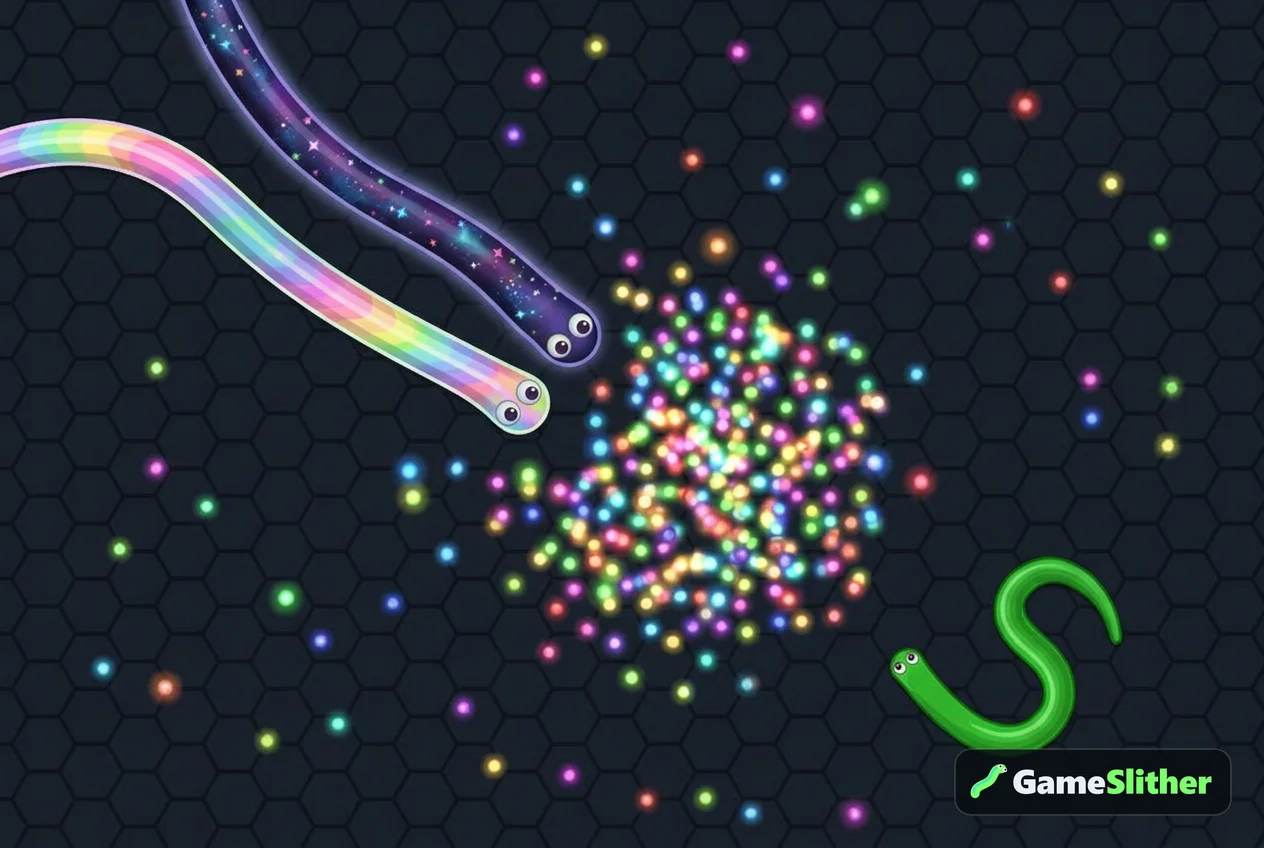
- Gluttons — they rush the pellet pile a defeated snake leaves behind. The moment a kill happens on the minimap, gluttons converge like seagulls on chips.
That last one is incredibly useful: if you just took someone down, expect company within a second or two. Coil around your own loot instead of eating it in a straight line.
Movement tells: the quick checklist
Here's the fastest read on who you're facing.
| Tell | Usually a bot | Usually a real player |
|---|---|---|
| Turning | Smooth, consistent arcs | Jittery micro-corrections, sudden flicks |
| Boost use | Short, situational bursts | Long panic boosts, often wasted |
| Reaction to your head | Responds to your body position | Responds to where you're about to go |
| Chasing pellets | Takes the nearest cluster | Ignores small food to hunt a kill |
| After a near miss | Carries on as if nothing happened | Circles back for revenge |
| Trapped against a wall of body | Commits to one arc | Freezes, then flails |
The revenge tell is the big one. Bots have no ego. Cut off a human, fail to finish them, and they will come back for you — often badly, often while boosting, often straight into your coil. That's free length.
The boost giveaway
Boosting burns length and drops pellets behind you, so it's a real cost. Bots spend it carefully. Humans, especially newer ones, hold the button down out of nerves and shrink themselves into snack size. If you see a mid-sized snake bleeding pellets across half the map for no tactical reason, that's a person panicking — and a buffet waiting to happen. (If that's you, read How to Boost Without Losing All Your Length.)
Reading the kill feed and leaderboard
You don't only identify opponents by watching them. Two other sources help:
- The kill feed. "X defeated Y" lines tell you who's actually converting encounters into kills. A name racking up multiple takedowns quickly is almost always a human playing aggressively.
- The leaderboard. Snakes that climb in bursts — big jump, pause, big jump — are usually players cashing in on defeated snakes' pellets. Steady, gradual growth is typical bot farming.
Also watch the skins. Anyone rolling an achievement skin like Inferno, Frost, Shadow or Aurora has earned it through real play, so treat them with respect. The same goes for shop flag skins — someone spent 500 coins on that. Browse the full lineup on the snake skins section.
How to play differently against each
Once you've made the call, adjust:
Against bots
- Bait shy ones toward a wall of your own body; they'll dodge predictably.
- Let hunters commit to a cut-off, then brake with a tight turn so they overshoot.
- Never eat a fresh pellet pile in a straight line — gluttons are already on the way.
Against real players
- Fake a turn. Bots don't fall for feints; humans absolutely do.
- Punish the revenge run. After a failed cut-off, hold a wide circle and wait.
- Watch their length bar. A shrinking human is a desperate human.
Want more general growth strategy? The 10 tips to top the leaderboard guide pairs nicely with this one.
Practice where it's quiet
If you want to study bot behaviour without 40 snakes breathing down your neck, make a private room and share the 4-character code with a friend — or just play it solo for a few minutes and watch the AI patterns up close. New to the controls? The how to play rundown takes thirty seconds.
Ready to test your bot radar?
Spotting snake game bots isn't a party trick — it's a decision shortcut. Bots are predictable fuel; humans are unpredictable threats with egos you can exploit. Open GameSlither in your browser, drop into a public room, and see how many opponents you can label correctly before your first death. No download, no sign-up, just you and 40 snakes.
Frequently asked questions
How many bots are in a GameSlither room?
Public rooms always hold about 40 snakes in total. The number of AI snakes shrinks as real players join, with up to 50 players per room.
Can you turn off snake game bots?
You can't disable AI snakes in public rooms, but you can create a private room and share its 4-character code or invite link so you play only with the friends you invite.
Do bots count toward kills and coins?
Yes — taking down any snake rewards you, and free play earns +5 coins per snake defeated plus +1 coin for every 10 length you reach.
What's the easiest sign I'm fighting a real player?
Revenge. Bots move on after a failed encounter, while human players circle back to try again, usually while boosting and losing length.
Are bots easier than real players?
Generally yes, because their behaviour follows set personalities — shy, hunter or glutton — so you can predict their next move once you recognise the pattern.