How to Survive as a Small Snake in Slither io: 10 Tips
Contents
- Why small snakes die (and why it is almost never bad luck)
- Your first 60 seconds: the safe start routine
- Learn to read space, not snakes
- Boost is a tool, not an escape button
- Understanding who you are playing against
- Surviving the three classic small-snake traps
- Turning survival into real growth
- Practice without the pressure
- Start small, finish long
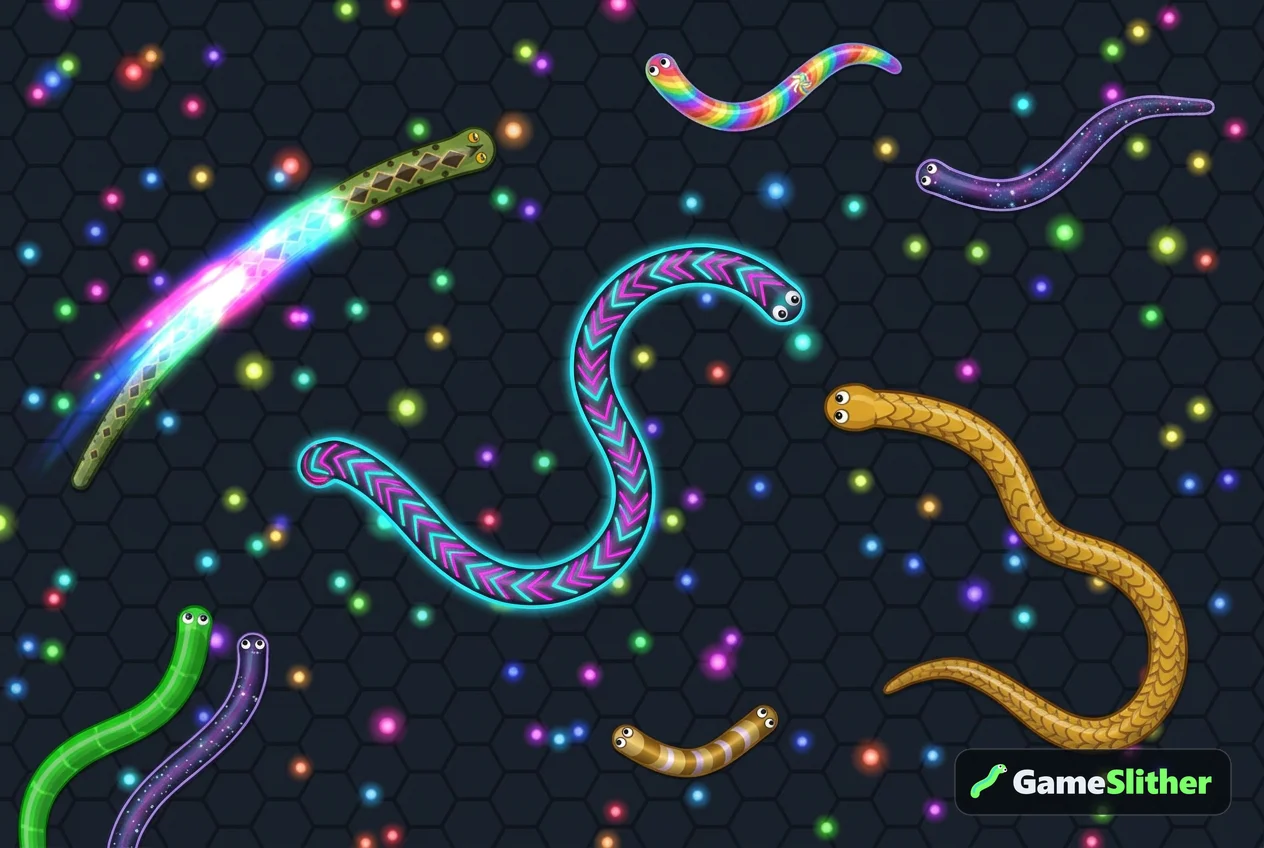
Being small in a snake io game is not a punishment — it is a stage, and it is the stage where you actually have the most agility. A short snake turns in a tighter circle, needs far less open space, and can slip through gaps a 2,000-length giant can only stare at. This guide explains, slowly and in plain language, how to survive as a small snake in Slither io style games such as GameSlither, from your very first second on the map to your first clean takedown.
Why small snakes die (and why it is almost never bad luck)
When you are new, death feels random. One moment you are eating pellets, the next the screen flashes and the kill feed says someone defeated you. It rarely is random. Almost every early death comes from one of a handful of repeatable mistakes.
Here are the big ones:
- Chasing food with your eyes, not your head. You lock onto a glowing pellet, drive straight at it, and never notice the body segment lying across your path.
- Panic boosting. Something scary appears, you hold boost, and you launch yourself straight into the thing you were trying to escape.
- Tailgating a big snake. Following a long snake looks safe because it is going somewhere. Then it turns, and its body sweeps across your nose.
- Standing in a death pile. When a snake is defeated it leaves a bright trail of pellets. That food is real, but so are the four hungry snakes arriving at the same time.
- Driving with no idea where you are. If you never glance at the minimap, you cannot tell whether you are drifting into the busiest part of the map.
Notice that none of these are about reflexes. They are about attention and decision-making, which is good news: both improve fast once you know what to look at. If you want a deeper breakdown of the classic errors, we covered them in 7 snake io beginner mistakes that kill you fast.
The one rule that beats every other tip
Your snake dies when your head touches another snake's body. Your body is not a weapon that can be hurt — it is just a long tail you drag behind you. That single fact changes everything. It means a small snake is not "weaker" in a fight; it simply has a shorter trail to manage. Protect your head, and you can survive next to snakes ten times your size.
Your first 60 seconds: the safe start routine
The opening minute decides most games. Spawn, panic, die in 15 seconds, repeat — that is the loop most beginners get stuck in. Replace it with a routine.
- Do not move much for the first two seconds. Let the screen settle. Find your own snake head and get a feel for which way the mouse is pulling you.
- Look outward, not inward. The middle of a public room is usually the busiest place, because big snakes orbit there hunting each other. Pick a direction with fewer snake bodies on screen and drift that way.
- Eat the small, scattered pellets first. They are slow food, but they are safe food. You are buying time to learn the room, not racing anyone.
- Glance at the minimap every few seconds. It shows you where you sit on the map. Build the habit now, while nothing is chasing you — later you will not have time to learn it.
- Keep your boost finger off the button. For the first minute, treat boost as if it does not exist.
If you are completely new to the controls — mouse, touch, boost with left click, Space or the ⚡ button — read the short how to play rundown first so the basics are already muscle memory.
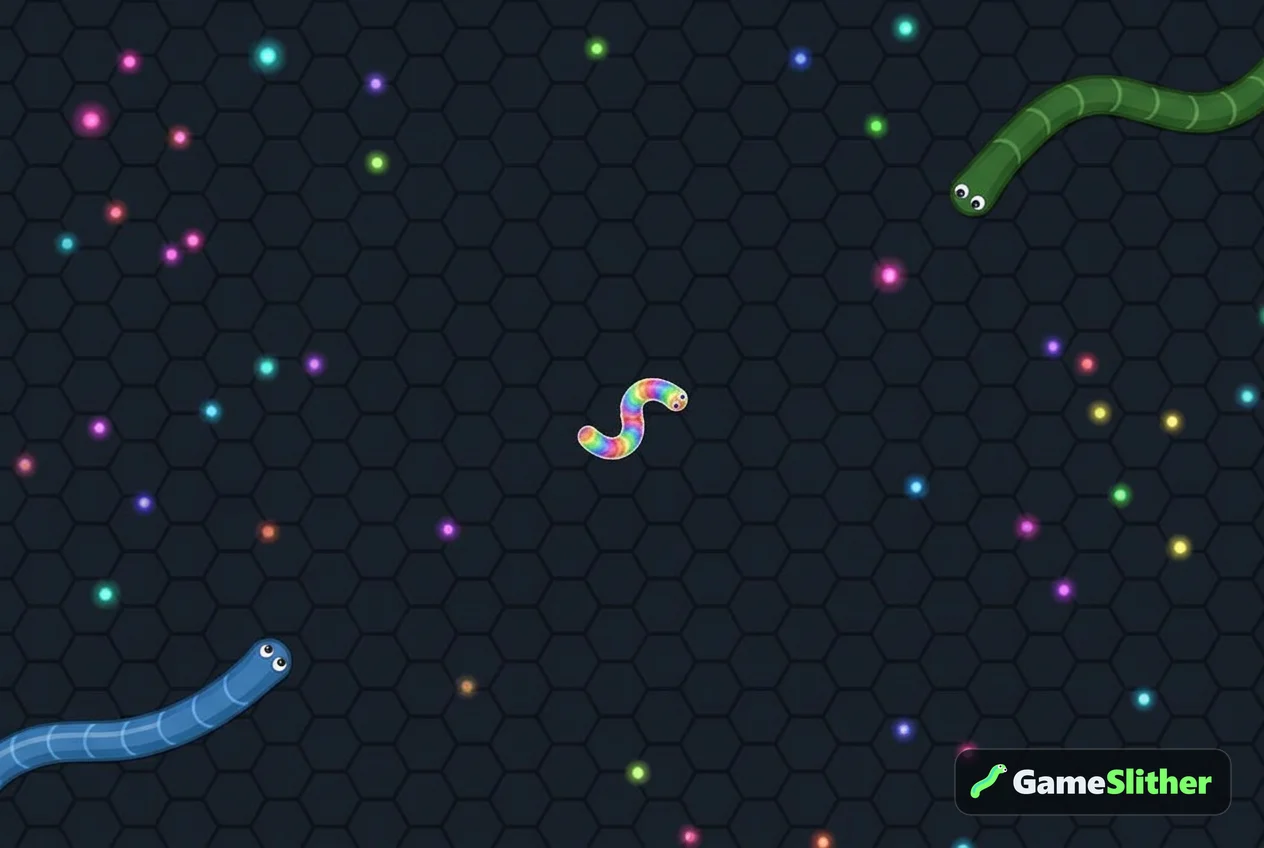
Why "boring" is the correct opening
A quiet first minute feels unproductive. It is not. Every second you stay alive you are eating, and length compounds: a bigger snake covers more pellets with the same movement. Players who survive two slow minutes routinely end up longer than players who had three wild, exciting lives in the same time. Survival is the growth strategy. There is a full guide to that idea in how to grow fast in snake io without dying early.
Learn to read space, not snakes
Beginners watch snakes. Experienced players watch the gaps between them. That is the single biggest change in how you see the screen.
When you look at a crowded area, ask three questions:
- Where is the nearest empty corridor?
- If the snake in front of me turns toward me, do I have an escape on my left or my right?
- Am I about to enter a space with only one exit?
That last one is the killer. A small snake that swims into a pocket surrounded by bodies has no room to turn. Big snakes know this and will happily close the door behind you.
The "always have two exits" habit
Make it a rule: never commit to a direction unless you can name two ways out. Two exits means one can be taken away and you still live. One exit means you are gambling. No exits means you have already lost and just do not know it yet.
This habit costs you nothing in food. You simply approach pellets from the open side instead of the closed side.
Use your turning radius
A small snake turns almost on the spot. A very long one swings like a bus. When a bigger snake tries to cut across your path, the correct answer is usually a sharp turn back the way you came, not a straight-line sprint. You are faster at changing direction than they are, and they cannot follow you into a tight loop without wrapping their own body into a shape they then have to escape.
Boost is a tool, not an escape button
Boosting costs length and drops pellets behind you — which means every panic boost makes you smaller and feeds the snake chasing you. Small snakes can genuinely not afford it. Learn the difference between a boost that saves you and a boost that kills you.
| Situation | Boost? | What to do instead |
|---|---|---|
| A big snake is drifting near you | No | Turn away calmly; you are faster at turning |
| You are about to be cut off, gap closing in under a second | Yes, short tap | One quick tap through the gap, then release |
| Racing a rival to a big pellet pile | Usually no | Let them take the risk; eat the leftovers from the edge |
| You are trapped inside a coil | No | Hug the inside of the circle and look for the opening |
| You have a clean cut-off on a smaller snake | Yes | Short bursts, aim ahead of their head, not at it |
| You are scared and do not know why | Never | Slow down and look at the whole screen |
The rule of thumb: boost to finish something, not to start something. A tap is often enough. Holding boost for three seconds as a short snake can cost you a painful chunk of the length you spent two minutes collecting.
Practising short taps
In a quiet corner of the map, tap boost for half a second and watch how far you travel and how much you shrink. Do it five times. Now you know, physically, what one tap buys you. That knowledge is what stops your hand from clamping down in a panic later.
Understanding who you are playing against
A public GameSlither room always holds around 40 snakes — a mix of real players and AI snakes, with the AI stepping aside as more humans join (up to 50 players in a room). Knowing that mix helps, because the AI snakes behave in three readable ways:
- Shy snakes avoid anything bigger than them. If a snake keeps veering away from you, it is probably shy — safe to ignore, and easy to shepherd away from food you want.
- Hunters actively try to cut off smaller snakes. If something is angling across your front instead of following your tail, treat it as a hunter and break the chase immediately with a hard turn.
- Gluttons rush straight to the pellets left by a defeated snake. They are the reason death piles get crowded in seconds.
Against real players the same patterns show up, just less predictably. The useful takeaway is to classify every nearby snake within a second or two: avoiding me, chasing me, or ignoring me? You only need to react to the middle category.
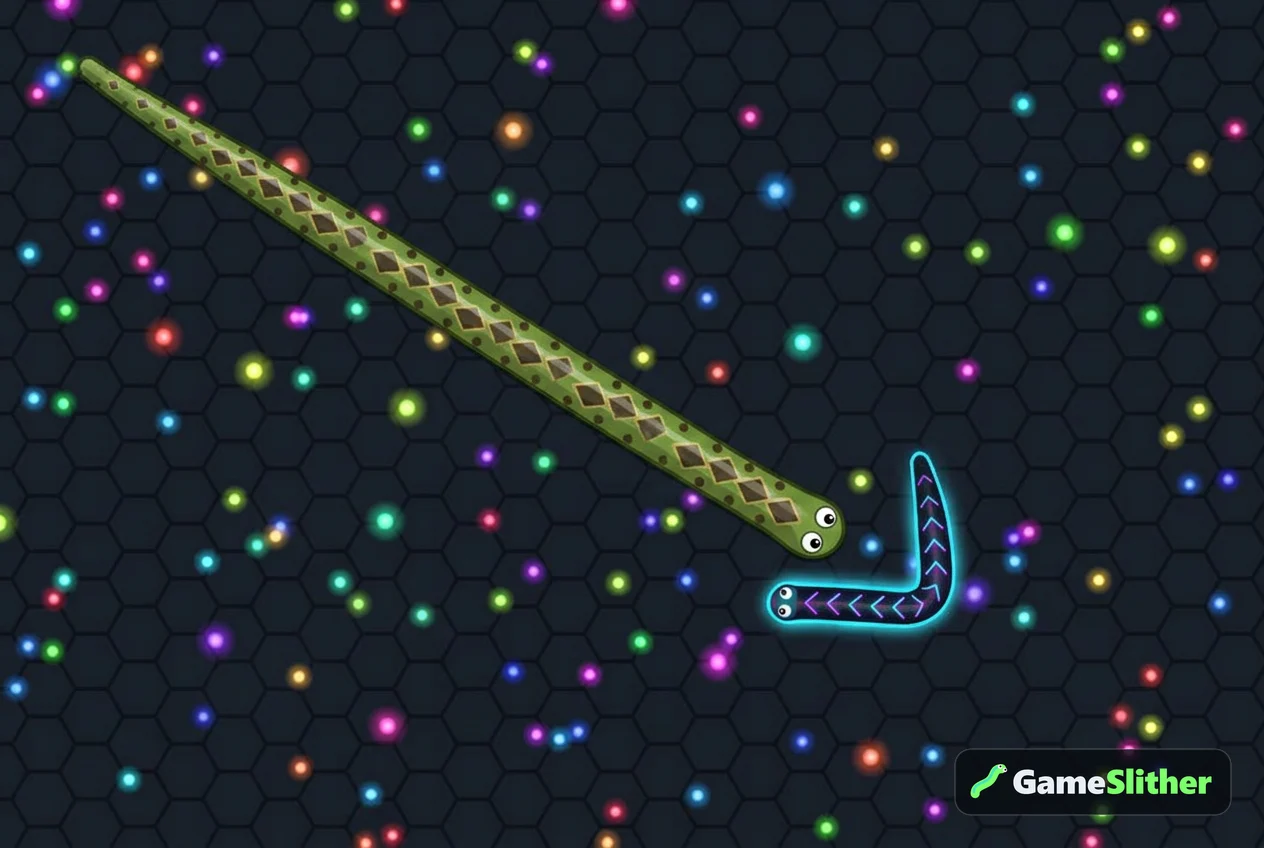
What a hunter's approach looks like
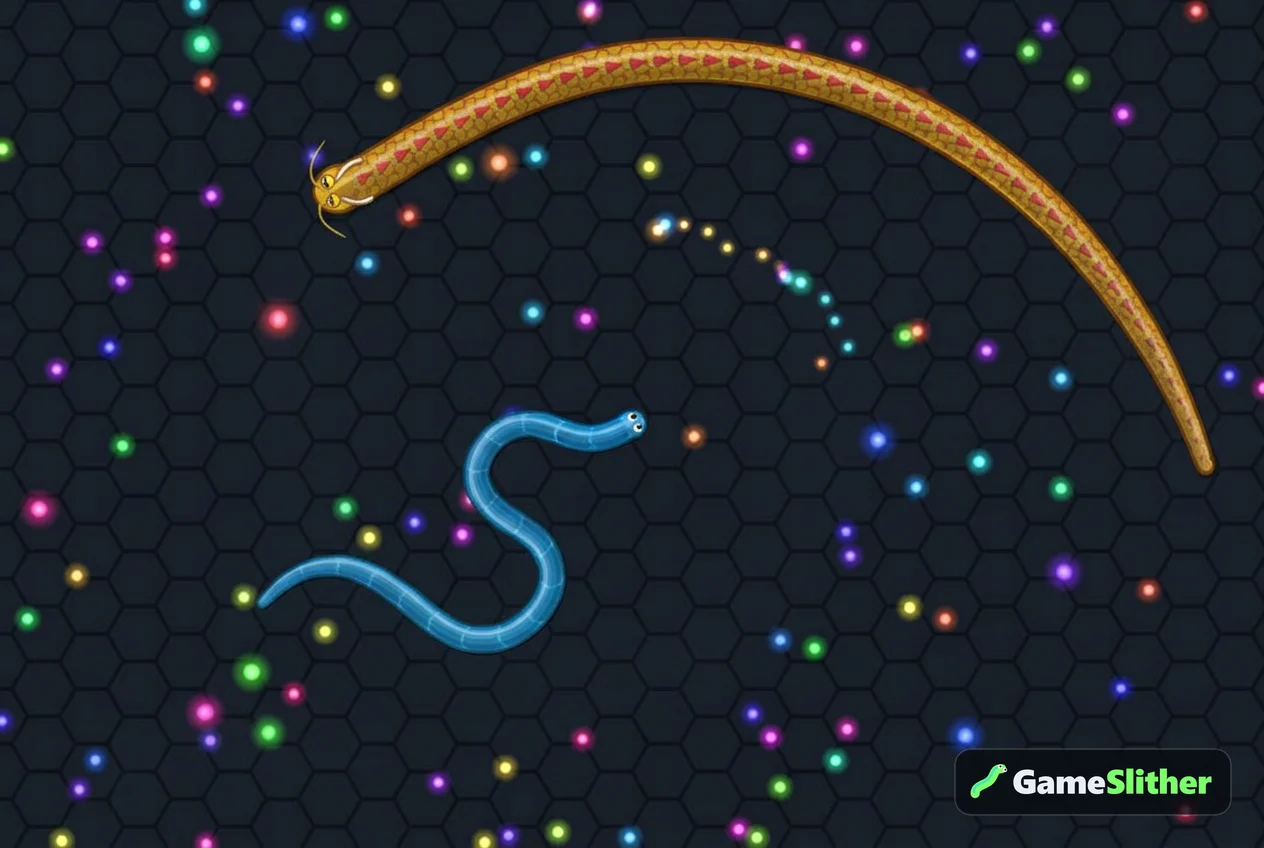
A hunter does not aim at where you are. It aims at where you will be. On screen that looks like a snake moving diagonally ahead of your nose, slowly tightening the angle. The moment you see that shape, do not try to outrun it in a straight line — you will lose, because their head is already in front of yours. Turn 90 degrees or more, away from the side they are approaching from, and make them reset the whole approach. Most of the time they give up and find an easier target.
Surviving the three classic small-snake traps
Trap 1: the encirclement
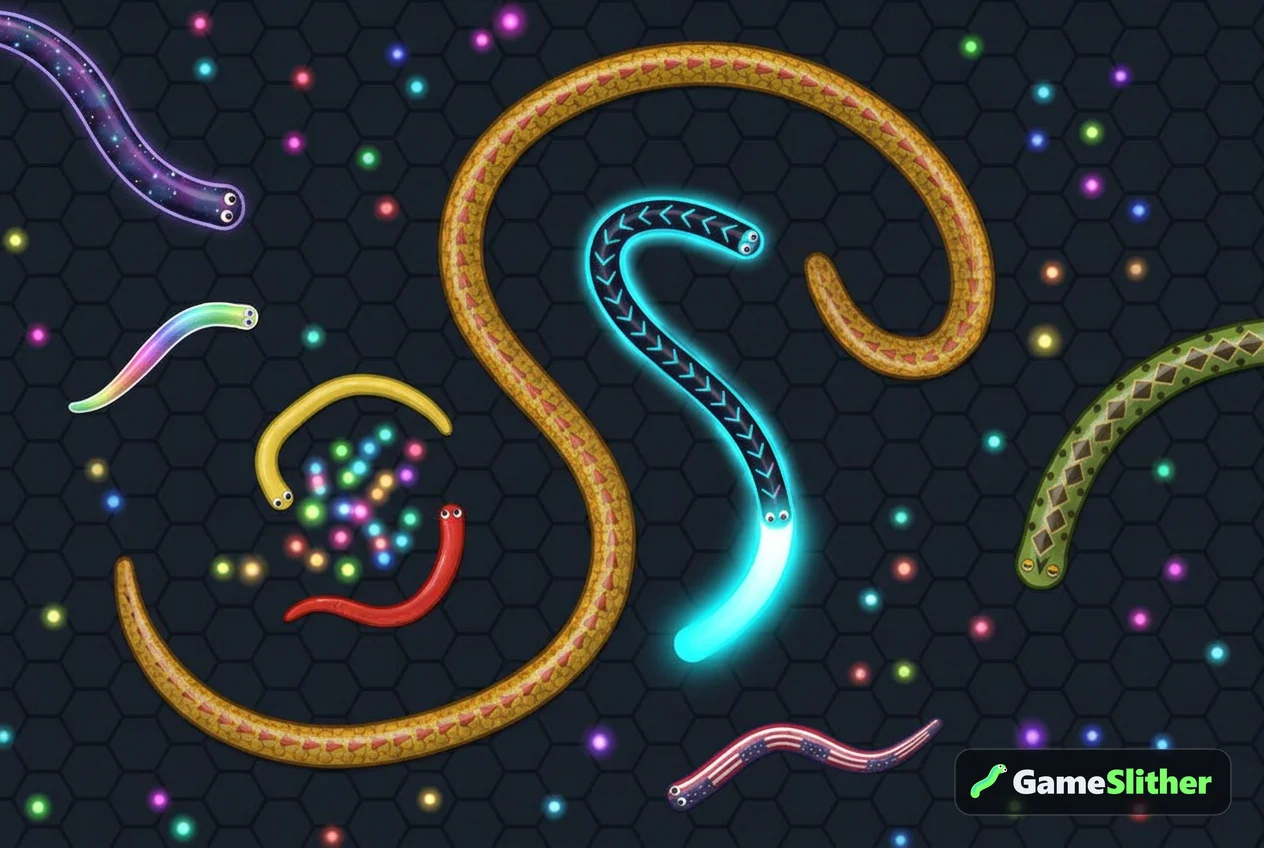
A long snake curls around you in a spiral, shrinking the circle until you have nowhere to go. It looks terrifying and it works on panicking players.
What to do: go to the inside edge and move with the coil, not against it. Circling snakes have to leave their head somewhere, and a spiral always has one open seam — usually behind the head or where the coil started. Stay calm, keep turning tightly in the free space, and the moment the coil loosens, slip out along the seam. A short tap of boost through the gap is one of the few boosts that is always worth it.
Trap 2: the head-on game of chicken
Two snakes drive straight at each other. Whoever flinches last wins — except as a small snake you should never enter this situation at all.
What to do: break the line early. The moment you see a head pointed at your head, turn 45 degrees away. You lose nothing. You are not losing a duel; you are refusing one. Head-on confrontations are high variance even between giants, and you have far more to lose than the big snake does.
Trap 3: the death pile
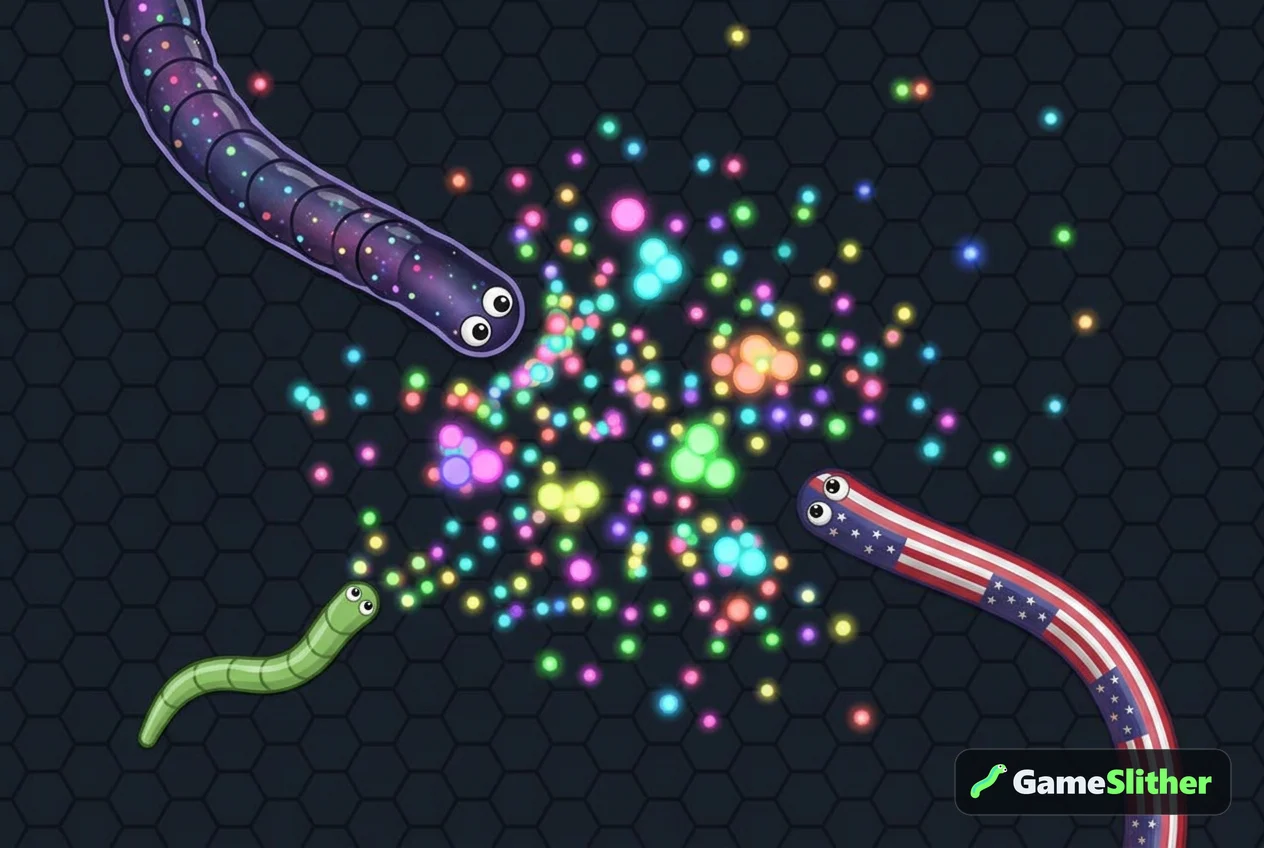
A snake dies nearby and the map lights up with pellets. Free food! It is also a magnet: hunters, gluttons and three other small snakes are all converging on the same spot, which means bodies crossing from every direction.
What to do: eat from the outside in. Approach the pile from the edge nearest open space, take a mouthful, and leave. Do not swim into the middle of the glow. Half a pile you survive is infinitely better than a full pile you die in. If two big snakes are already fighting over it, skip it entirely — the leftovers from their fight will be bigger anyway.
Turning survival into real growth
Once you can reliably stay alive for three or four minutes, you stop being a "small snake" at all. Here is how to convert safety into length efficiently.
- Farm the quiet lanes. Pellets regenerate across the map. A medium-busy area with steady food beats a crowded hotspot with lots of food.
- Shadow fights from a safe distance. When two bigger snakes commit to each other, position yourself a comfortable distance away, on the outside. When one dies, you are already closer to the edge of the pile than the gluttons sprinting in.
- Collect your own boost pellets. If you did have to boost, loop back and eat some of what you dropped — but only if nothing is chasing you.
- Take your first kill with a cut-off, not a collision. Pick a snake clearly smaller or equal to you, drive ahead of its head, and turn across its path so it runs into your side. Your head stays out of danger the entire time. Each takedown also pays you coins, which stack up toward the shop skins.
- Know when to cash in. Every life ends eventually. The result screen shows your max length, kills, time alive, best rank and coins earned — use it as a report card. If your "time alive" is creeping up each game, your survival skills are genuinely improving, even on runs where the length was modest.
Small snake vs big snake: what actually changes
| Small snake | Big snake | |
|---|---|---|
| Turning | Very tight, near-instant | Wide, slow to commit |
| Space needed | A narrow gap is enough | Needs a lot of open map |
| Boost cost | Expensive relative to your size | Cheap relative to your size |
| Best tactic | Avoid, slip through, farm quietly | Encircle, block, control space |
| Biggest danger | Being cut off in a tight pocket | Other big snakes and careless turns |
Read that table once more and you will see why copying what the leaderboard snakes do is a mistake. Their playbook requires mass you do not have yet. Yours requires patience you can start using immediately.
Practice without the pressure
If public rooms feel overwhelming, build your confidence in a calmer setting first.
- Create a private room and share the 4-character code or invite link with a friend. With two or three people, you get space to practise cut-offs, tight turns and escaping coils without 40 snakes on screen.
- Set yourself one goal per life. Not "get huge" — something like "survive four minutes" or "do not boost once". Single-focus practice teaches faster than general play.
- Use daily missions as structure. Missions such as reaching a certain length or surviving a number of minutes in one life nudge you toward survival habits, and they pay coins instantly.
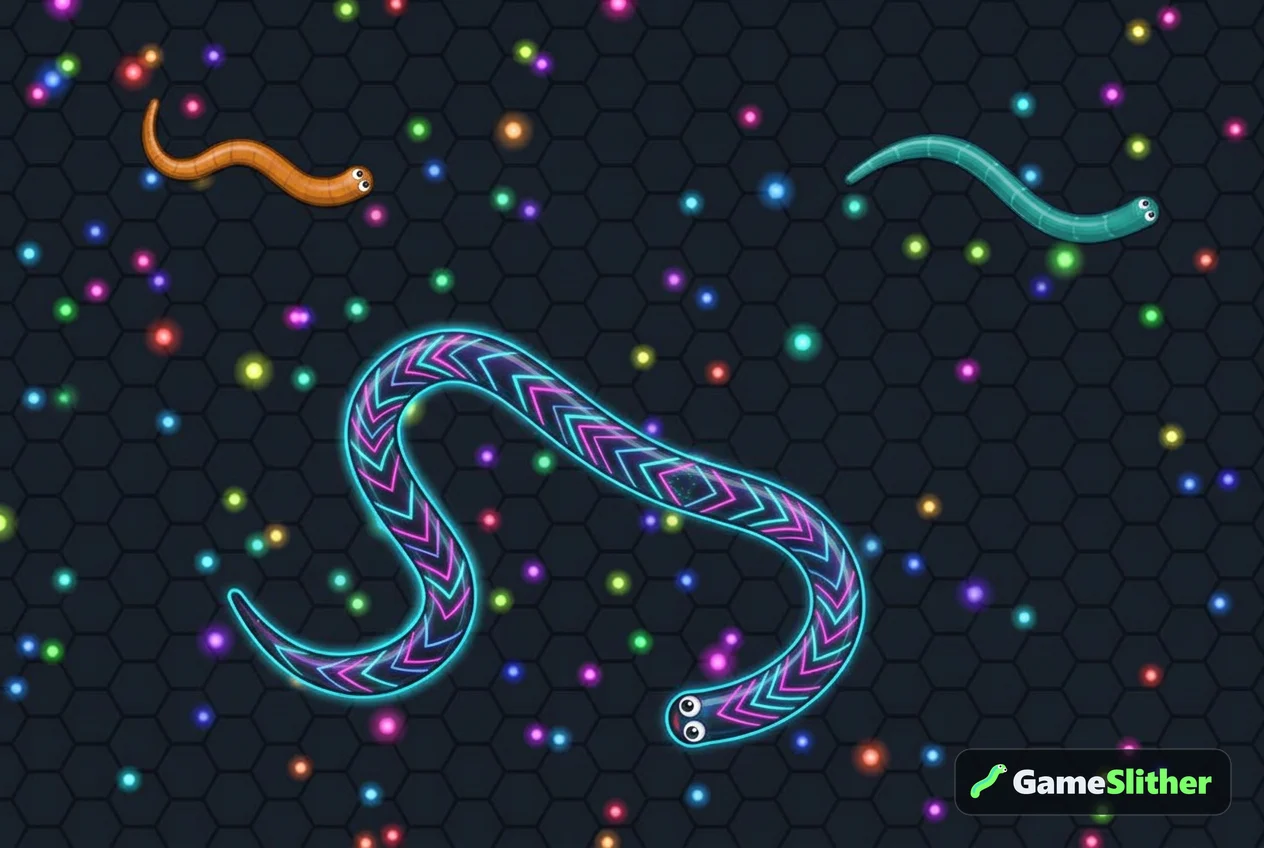
- Pick a skin you can actually see. This sounds trivial, but tracking your own head matters. Some players find a bright snake skin like Neon Cyber easier to follow than a dark one; others prefer something low-contrast so they stand out less. Try a few.
And if your long-term goal is an achievement skin, note how survival-focused they are: Frost asks for 10 minutes alive in a single life, Shadow for 5 takedowns in one life. Both reward exactly the habits in this guide.
Start small, finish long
Surviving as a small snake comes down to five things: protect your head, always keep two exits, treat boost as a scalpel instead of a panic button, classify nearby snakes as chasing or not chasing, and eat death piles from the outside in. None of it requires fast reflexes — just the willingness to be patient for the first two minutes while everyone else throws their life away.
The quickest way to make these habits stick is to use them in a live room, where real players and AI snakes keep you honest. Jump into a free round of GameSlither in your browser — no download, no sign-up — and give yourself one simple target: stay alive longer than last time. The length follows on its own.
Frequently asked questions
How do you survive as a small snake in Slither io style games?
Stay away from crowded areas for the first minute, eat scattered pellets instead of fighting for death piles, keep two escape routes open at all times, and save boost for short taps that get you through a closing gap. Your head is the only vulnerable part, so protect it and you can survive next to much bigger snakes.
Should a small snake use boost?
Rarely. Boosting costs length and drops pellets behind you, which is expensive when you are short and feeds anyone chasing you. Use single short taps only to escape a closing gap or finish a cut-off you have already set up.
How do you escape when a big snake coils around you?
Do not drive at the wall of body. Move with the coil along its inside edge, keep turning tightly in the free space, and look for the seam near the circling snake's head or where the spiral started — then slip out with one quick boost tap.
Is it safe to eat the pellets left by a defeated snake?
Only from the outside. Death piles attract hunters and glutton AI snakes from every direction, so take a mouthful from the edge nearest open space and leave rather than swimming into the middle of the glow.
How long does it take to stop dying early as a beginner?
Most players see a clear improvement within a handful of sessions once they stop chasing food blindly and start watching the gaps between snakes. Track the "time alive" number on the result screen — if it rises game after game, your survival habits are working.