7 Snake io Beginner Mistakes That Kill You Fast
Contents
- 1. Chasing pellets instead of reading space
- 2. Boosting with no purpose
- 3. Treating every snake as the same threat
- 4. Driving head-first at a bigger snake
- 5. Hugging the map edge for safety
- 6. Forgetting the minimap and the kill feed
- 7. Playing a 2,000-length run like a 200-length run
- Fix them in order, not all at once
Most short runs in a browser snake game are not bad luck — they are the same seven errors repeating. If you keep dying within half a minute of spawning, you are almost certainly committing at least three of the snake io beginner mistakes below, and every one of them has a mechanical fix you can apply in your next game. Here is the breakdown, from the most lethal to the most subtle.
1. Chasing pellets instead of reading space
New players lock their eyes on the nearest glowing dots and follow them like a magnet. The problem is that pellets sit inside contested space — especially the dense piles left by a snake that just died, which attract every glutton-style AI and every greedy human in the area.
The fix is a two-step scan before you commit:
- Look at the pellets you want.
- Look at the exit you will use after eating them.
If you cannot name the exit, do not go in. Veterans eat from the edge of a pile and peel away, rather than driving into the middle of it.
2. Boosting with no purpose
Boosting feels fast and powerful, so beginners hold the button constantly. Two things happen: your length drains away, and your turning circle widens dramatically, which is exactly how you clip the body you were trying to dodge.
In GameSlither, boost costs length and drops pellets behind you — effectively feeding whoever is chasing you. Reserve it for three situations only:
- Cutting off a snake whose head you can get in front of.
- Escaping a closing wall of body.
- Claiming a pellet pile a split second before a rival reaches it.
If you want a deeper breakdown of the cost/benefit, read how to boost without losing all your length.

3. Treating every snake as the same threat
A lobby holds roughly 40 snakes, a mix of real players and AI with three distinct personalities: shy snakes that avoid anything bigger, hunters that try to cut off smaller targets, and gluttons that sprint at the remains of a kill. Reacting to all of them identically wastes energy and gets you killed by the one that actually matters.
| Behaviour you see | Likely type | Correct response |
|---|---|---|
| Turns away as you approach | Shy AI or cautious player | Ignore it, keep farming |
| Angles ahead of your head, not at your body | Hunter | Turn early, break the intercept line |
| Beelines past you toward loose pellets | Glutton | Let it pass, or cut across its path |
| Mirrors your turns unpredictably | Likely a real player | Treat as the top threat |
Telling them apart is a learnable skill — bots vs real players covers the tells in detail.
4. Driving head-first at a bigger snake
The genre rule is simple: whoever's head touches a body loses, regardless of size. Beginners see a huge snake, panic, and steer straight at it, assuming size wins. It does not — but a long snake has far more body to run into, and far more reach to coil around you.
Never approach a larger snake from the side of its body. Approach from behind its head, keep a full body-width of margin, and remember that a big snake turning toward you is setting up a wall, not making a mistake.
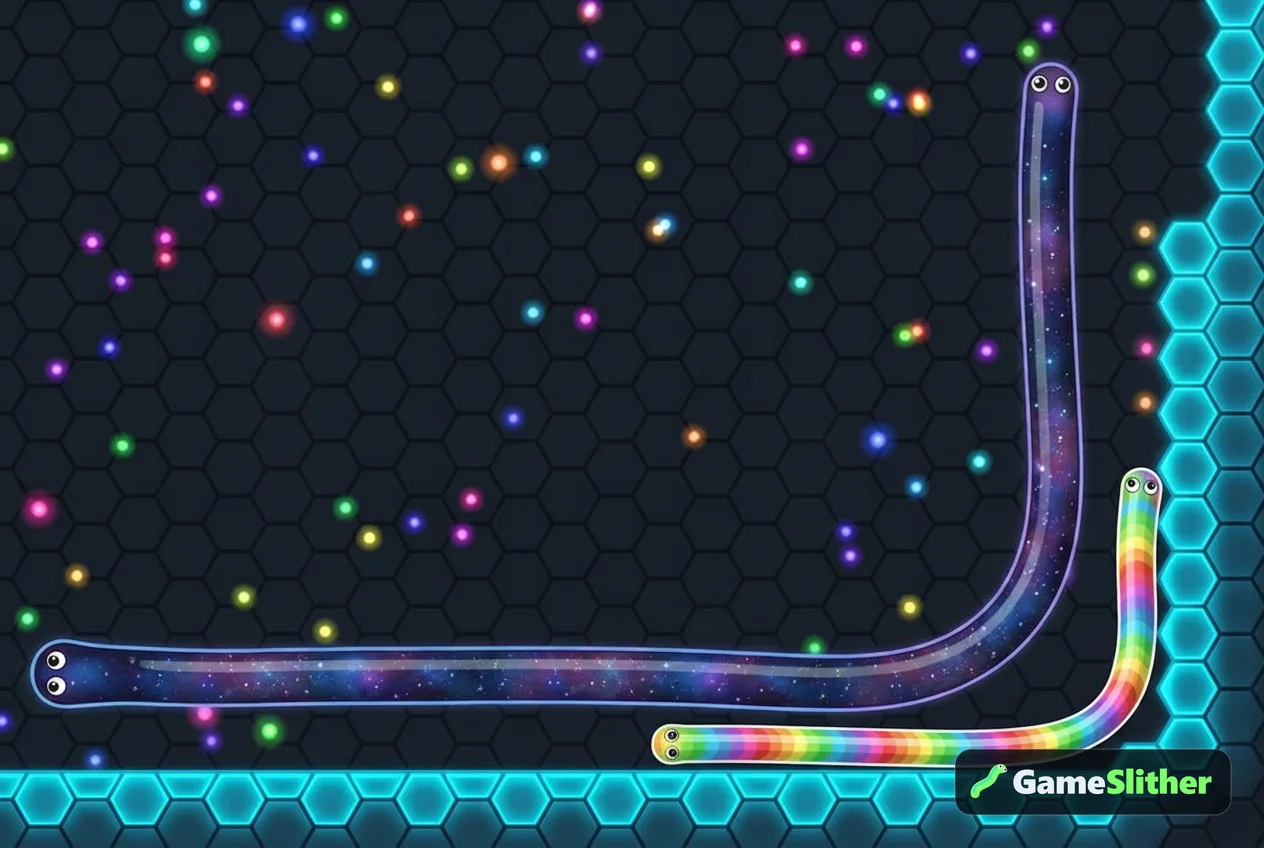
5. Hugging the map edge for safety
The border looks like a safe wall to back against. In practice it removes half your escape options. Hunters know this and will simply drive parallel to the edge, squeezing you into a corridor with no out.
Stay in the middle third of the map when you are small. Food density is similar, and you always have 360 degrees of escape.
6. Forgetting the minimap and the kill feed
The minimap tells you where the crowd is. The kill feed tells you a big pile of pellets just appeared somewhere nearby and that several snakes are already converging on it. Beginners never glance at either, then wonder why three snakes arrived at once.
Build a rhythm: every few seconds, flick your eyes to the minimap, then back. It costs nothing and removes most "where did that come from?" deaths.
A quick cadence that works
- Eat for 3–4 seconds.
- Glance at the minimap.
- Reposition toward emptier space.
- Repeat.
7. Playing a 2,000-length run like a 200-length run
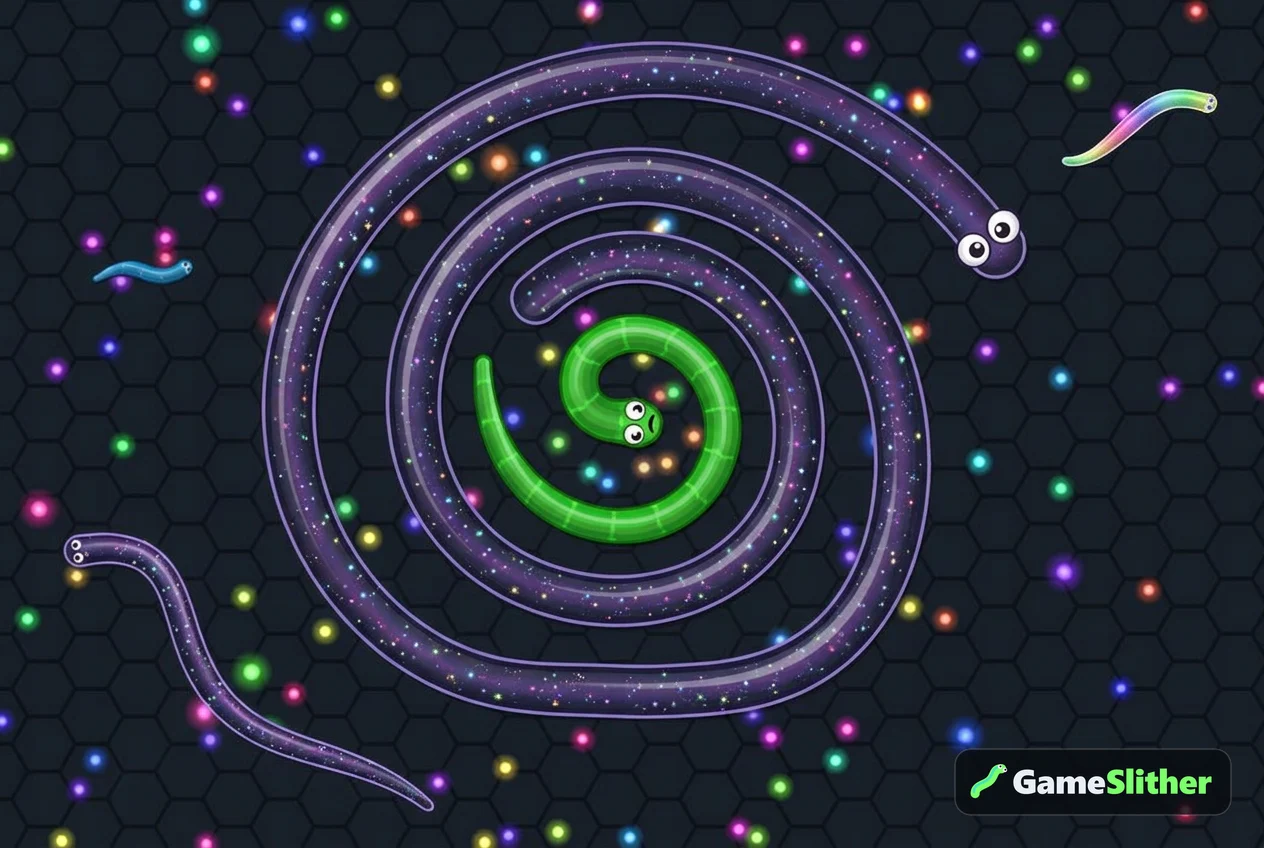
The final mistake is the one that ends promising games. A long snake is slower to turn, easier to trap, and a trophy for every hunter on the server. Yet many players keep taking the same aggressive dives that worked when they were tiny.
As you grow, change gears:
- Trade aggression for coiling — circle smaller snakes instead of racing them.
- Avoid crowded clusters entirely; your length is already your income.
- Keep a mental note of where your own tail is, especially while coiling.
If you are curious about the pacing of a serious run, how long it takes to reach 1,000 length sets realistic expectations.
Fix them in order, not all at once
Trying to correct seven habits in one game produces hesitation, and hesitation kills too. Pick one per session: spend a few rounds only fixing your boosting, then a few rounds only watching the minimap. Survival time climbs quickly once each habit becomes automatic.
The quickest way to unlearn these snake io beginner mistakes is repetition in real lobbies. Jump into GameSlither — it runs in your browser with no download and no sign-up — and if you want the mechanics refreshed first, skim the how to play guide before your next spawn.
Frequently asked questions
Why do I die so fast in snake io games?
Almost always because you chase pellets without planning an exit, or you boost constantly and widen your turning circle. Fixing those two habits alone usually doubles the length of a typical run.
Does being bigger protect you in a snake io game?
No. Whoever's head touches another snake's body loses, no matter the size. A bigger snake is harder to trap in open space but also slower to turn and more valuable as a target.
Should beginners boost at all?
Yes, but only with a purpose: cutting off a snake, escaping a closing trap, or claiming pellets a moment before a rival. Boosting costs length and drops pellets behind you, so aimless boosting feeds your pursuers.
How can I tell if I'm fighting an AI snake or a real player?
AI snakes in GameSlither follow three readable patterns — shy, hunter or glutton — so their movement repeats. Real players turn unpredictably and often fake one direction before committing.
Is it safer to play near the edge of the map?
No. The border cuts your escape routes roughly in half, and experienced snakes will pin you against it. Stay in the middle third of the arena while you are still small.