How Long to Reach 1000 Length in a Snake Game
Contents
If you are wondering how long to reach 1000 length in a snake game, the honest answer for most players is somewhere between 8 and 15 minutes of careful, uninterrupted play. Experienced players who find a big pellet spill early can get there in 4 to 6 minutes; complete beginners often need two or three attempts before a single life lasts long enough. The number itself matters less than the habit behind it: staying alive is what makes you long, not speed.
This guide explains, step by step, where length actually comes from, what a realistic timeline looks like, and the common beginner mistakes that quietly reset your progress to zero.
What "length" actually means and where it comes from
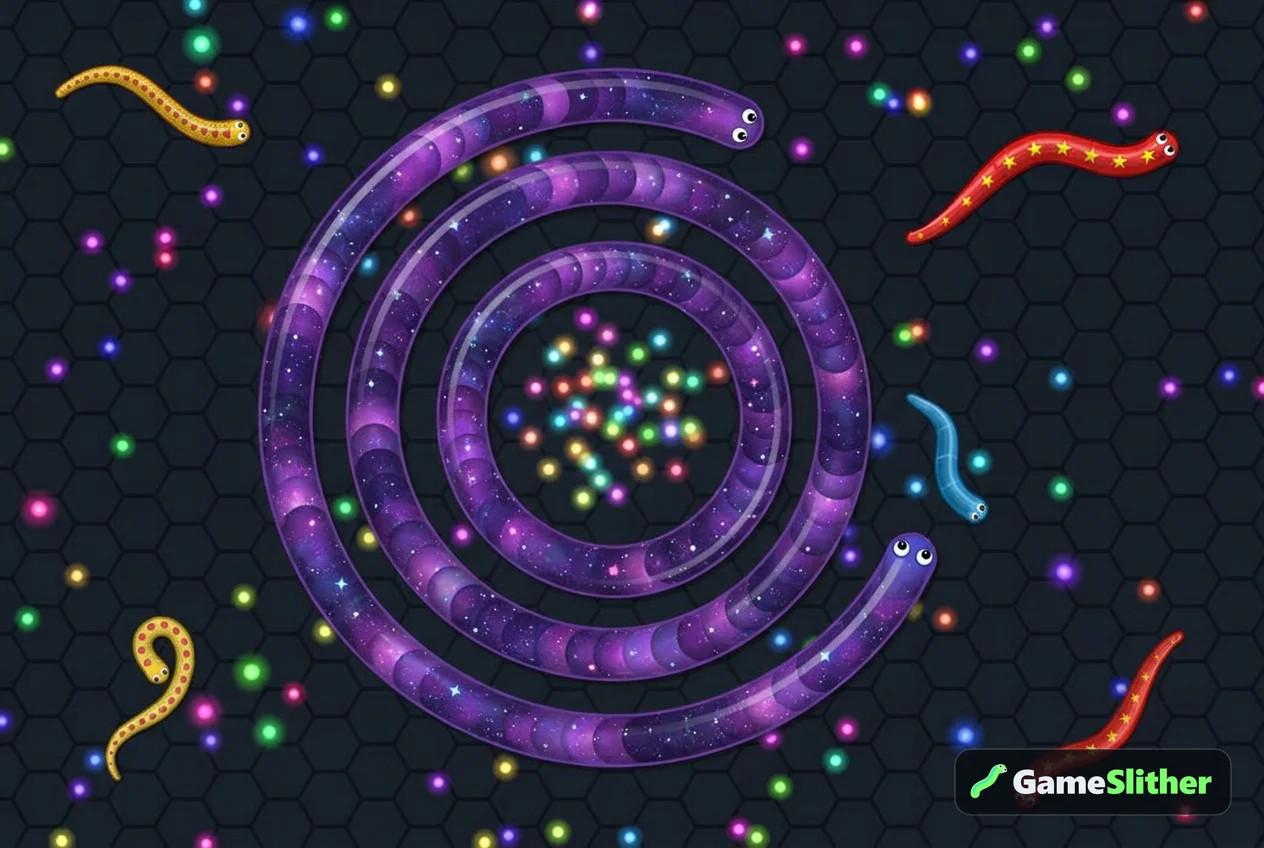
In a Slither.io-style snake game, your score is your length — the size of the trail you drag behind you. You start tiny, and there are only two ways to get bigger:
- Eating pellets. The small glowing dots scattered across the map. Each one adds a little length. This is slow but completely safe if you watch your surroundings.
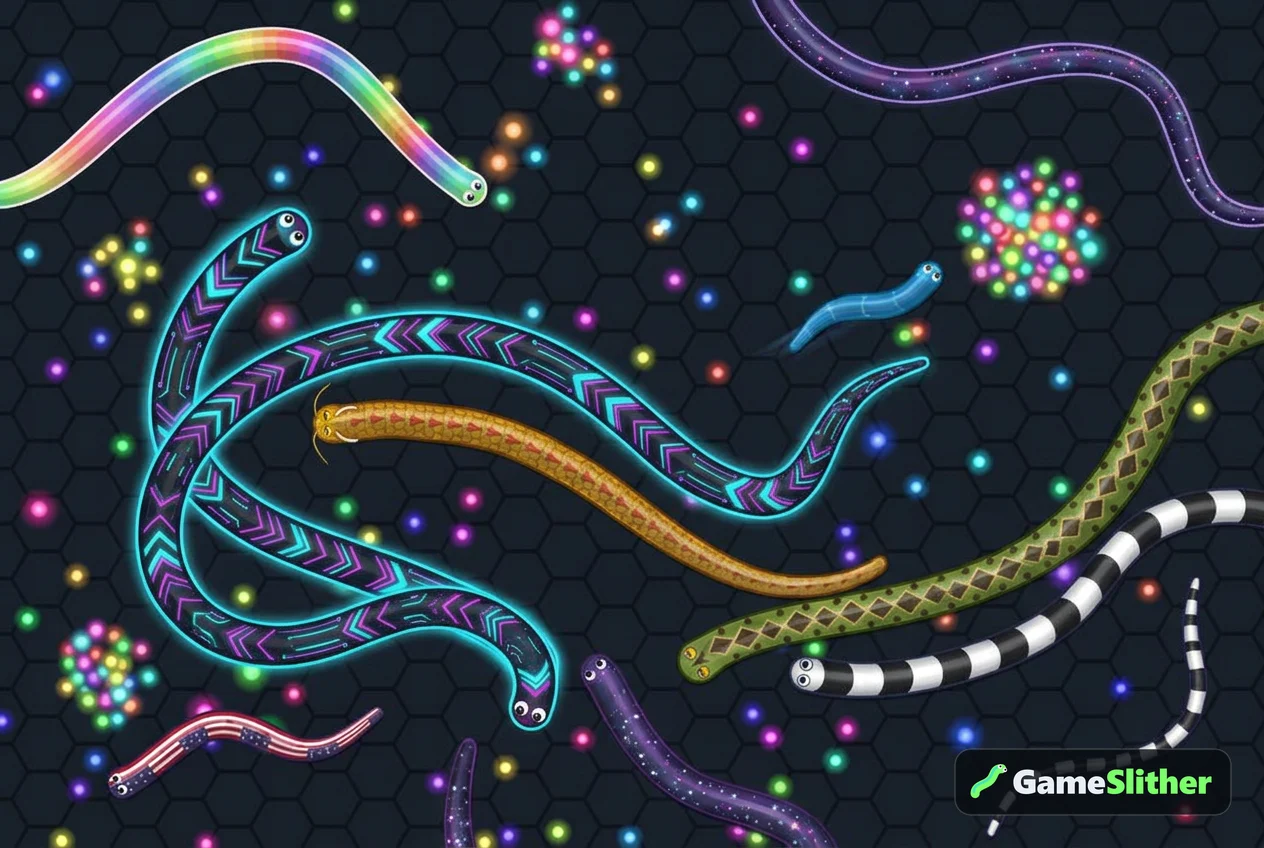
- Eating the remains of a defeated snake. When any snake crashes into another snake's body, it explodes into a long line of bright pellets. Those pellets are worth far more than scattered map food, and a single big spill can add hundreds of length in a few seconds.
That second source is the reason growth is never linear. You can crawl along for four minutes gaining a steady trickle, then double your size in fifteen seconds because a 900-length snake died right next to you.
Boosting costs length
On GameSlither you boost by holding left click, pressing Space or tapping the ⚡ button. Boosting burns your own length and drops pellets behind you. It is a tool, not a travel speed — a beginner who boosts constantly will never pass 300. If that is your habit, read our guide on how to boost without losing all your length before your next run.
A realistic timeline to 1,000 length
Here is roughly how a clean, survival-focused run tends to unfold. Times are approximate and depend heavily on how busy the room is.
| Phase | Length | Typical time | What you should be doing |
|---|---|---|---|
| Starting out | 0–100 | 0–2 min | Eat loose pellets on the quiet outer areas, avoid every other snake |
| Finding your feet | 100–300 | 2–5 min | Keep feeding, start circling small clusters of food |
| First real growth | 300–600 | 5–9 min | Hover near fights, collect leftovers, no risky plays |
| The stretch | 600–1,000 | 9–15 min | Use your length to trap smaller snakes, feed on the spills |
So the honest range is 8–15 minutes for a typical player. With one lucky spill it can be half that. Without one, a patient feeder can still get there — it just takes longer.
Why your first attempts take longer
New players almost never die from bad luck. They die because they:
- boost toward food that another snake reaches first;
- turn too sharply and clip their own body;
- chase a kill into the middle of three other snakes;
- panic when a big snake approaches instead of simply turning away.
Each of those sends you back to zero. If your average life is two minutes, 1,000 length is mathematically out of reach — the fix is not faster play, it is longer play.
The fastest safe route: feed on the aftermath
The single biggest accelerator is being near a fight without being in it. When two snakes collide, the loser leaves a glowing trail of pellets. Whoever arrives first eats most of it.
How to do this safely as a beginner:
- Watch the kill feed and the minimap for activity, but do not sprint across the map — you will burn length getting there.
- Stay about one screen away from any large snake. That is close enough to react, far enough to escape.
- When a spill appears, approach along the outside edge of it. Eat from the end, not from the middle where other snakes converge.
- If a bigger snake arrives, leave immediately. Half a spill is better than zero length.
On GameSlither you will often be sharing those pellets with AI snakes. One of the three AI personalities is the glutton, which rushes straight at the remains of a defeated snake — so expect company. The shy ones back off from anything bigger, and the hunters try to cut off smaller snakes. Knowing which one you are looking at changes how aggressive you can be; our article on telling bots and real players apart goes into the tells.
Habits that reliably get you past 1,000
1. Pick the edges early
The centre of the map is where the big snakes and the big fights are. Until about 300 length, stay on the quieter outer areas. You grow slower, but you grow consistently, which is the whole game.
2. Circle, don't chase
When you find a patch of pellets, loop around it in wide circles instead of darting from dot to dot. Circling keeps your head pointed at food, keeps your body behind you, and means you are never turning at a sharp angle you cannot escape.
3. Use your length as a wall
Once you are past 500, you are genuinely dangerous. Swinging your body in front of a smaller snake forces it to turn or crash. You do not need to boost — a long, calm arc works better than a desperate sprint, and it costs you nothing.
4. Boost in short taps only
A half-second tap to escape a cut-off, or to beat someone to the last section of a spill. Never a three-second hold. On GameSlither, every boost drops pellets that a nearby snake will happily eat.
5. Accept that retreating is progress
A 700-length snake that runs away still has 700 length. A 700-length snake that fights a 2,000-length snake usually has zero. There is no prize for bravery here.
How your setup and room affect the time
A few practical factors genuinely change how fast you grow.
Controls. Mouse steering on a desktop gives the finest control, which means fewer accidental self-collisions. Touch works well too, but take a moment to get comfortable before judging your own skill — see our controls comparison if you are switching devices.
How busy the room is. GameSlither public rooms always hold about 40 snakes, with AI snakes stepping aside as real players join (up to 50 per room). A busy room means more deaths, more spills and faster growth — but also more danger. A quieter stretch means safer, slower feeding.
Practice rooms with friends. If you want to learn the mechanics without pressure, create a private room, share the 4-character code or the invite link, and experiment. There is no leaderboard pressure, and you can practise trapping manoeuvres on someone who will not mind. Our guide to playing in a private room covers the setup.
What happens after you hit 1,000
Reaching four digits is a milestone, not a finish line. A few things follow naturally:
- Coins. On GameSlither you earn +1 coin per 10 length reached and +5 per snake taken down, so a 1,000-length run is worth a meaningful amount on its own. Stack that with daily missions and the coins add up quickly.
- Skins. Coins unlock the 23 country-flag skins in the shop at 500 coins each, on top of the 6 free snake skins everyone starts with.
- Achievements. The Inferno skin requires 1,500 length in a single life — so if you can do 1,000, you are already most of the way there. Frost (10 minutes alive), Shadow (5 kills in one life) and Aurora (7-day login streak) round out the achievement skins.
- The hall of fame. Weekly and all-time rankings track the longest snake in a single life, so your best run has somewhere to live.
When your run does end, the result screen shows your max length, kills, time alive, best rank and coins earned, plus a Share button that builds a result image. It is the quickest way to see whether you are actually improving — if your average time alive is climbing, your length will follow. We break the screen down in what happens when you die.
The short version
So, how long to reach 1000 length in a snake game? Plan for 8 to 15 minutes on a good run, faster if a big snake dies nearby, slower if you are still learning to read the map. The players who get there consistently are not the quickest — they are the ones who stop boosting without reason, stay on the edges while small, and treat retreating as a win.
GameSlither is free, runs in any browser on desktop, mobile or tablet, and needs no download or sign-up. Read the quick how to play rundown, then start a run and see how far one patient life takes you.
Frequently asked questions
Is 1,000 length good in a snake game?
It is a solid milestone that usually puts you near the top of the live leaderboard in a busy room. Top players go much higher in long lives, but 1,000 means you have survived long enough to play well rather than just luckily.
Can I reach 1,000 length without killing anyone?
Yes. Eating scattered pellets alone will get you there — it simply takes longer, often 15 minutes or more. Collecting the pellets left behind when other snakes crash into each other is the fastest no-risk shortcut.
Does boosting help me grow faster?
No. Boosting costs length and drops pellets behind you, so holding it down shrinks you. Use short taps only to escape danger or to beat someone to a pellet spill.
How long does it take to reach 1,500 for the Inferno skin?
If you can reliably hit 1,000 in around 10 minutes, 1,500 usually takes 15–20 minutes in a single uninterrupted life. See the achievement skins guide for the other three unlocks.
Do AI snakes make it easier or harder to grow?
Both. Shy AI snakes avoid you once you are bigger, which makes early feeding safer, but gluttons race you to pellet spills and hunters actively try to cut off smaller snakes.