Why Are io Games So Popular? 6 Reasons They Win

Contents
- First, what actually is an "io game"?
- Reason 1: You are playing within 10 seconds
- Reason 2: The rules fit on a napkin — but mastery takes months
- Reason 3: Real people make every match unpredictable
- Reason 4: Matches are short, so there's always "one more"
- Reason 5: Free progress that doesn't nag you
- Reason 6: They work on everything, with anyone
- io games vs traditional online games, side by side
- The takeaway
If you have ever wondered why are io games so popular, the short answer is this: they load in seconds, anyone can understand the rules in one match, and you are playing against real people without downloading anything or creating an account. That combination is rare. Below, I'll break down the six reasons these games keep winning — in plain language, with no gaming jargon assumed.
First, what actually is an "io game"?
An "io game" is a small multiplayer game you play directly in your web browser. The name comes from the .io web address ending that the early hits used — it was never an official category, it just stuck.
Most io games share the same recipe:
- You control one simple thing (a snake, a cell, a tank, a car) with your mouse or finger.
- Everyone is on the same map at the same time.
- You start small, grow by collecting something, and get bigger than everyone else.
- When you die, you restart immediately — no waiting room, no penalty.
GameSlither is a snake-style example: you steer a glowing snake around an arena, eat pellets to grow, and try to make rival snakes crash into your body. If you want the full beginner vocabulary — "pellets", "boost", "cut off", "orb" — there's a friendly glossary of snake io terms that explains each one.
Reason 1: You are playing within 10 seconds
This is the biggest single reason, and it is worth saying slowly.
A normal online game asks you to: download an installer, wait, create an account, verify an email, sit through a tutorial, then queue for a match. That is twenty minutes before the fun starts. An io game asks you to: open a link, type a nickname, press play.
That's it. No install, no sign-up, no launcher. On GameSlither you are steering a snake before a traditional game would have finished downloading. If you've never done it, the how to play guide takes about a minute to read.
That low barrier changes who plays. People who would never call themselves "gamers" will click an io game link on a break, on a school computer, or on a phone in a waiting room — because there is nothing to commit to.

Reason 2: The rules fit on a napkin — but mastery takes months
Good io games follow the old arcade principle: easy to learn, hard to master.
In a snake io game, the entire rulebook is two lines:
- If your head touches another snake's body, you die.
- If their head touches your body, they die.
A six-year-old understands that instantly. But underneath those two lines sits a surprising amount of depth: when to boost (boosting costs length and drops pellets behind you), how to curve in front of a bigger snake without clipping it, when to walk away from a fight you are losing, how to farm the pellet explosion left by a dead snake without being the next one to die.
That gap between understanding the game and being good at it is exactly what keeps people coming back. Most new players die in the first thirty seconds to the same handful of errors — all of them fixable once you know them. There's a breakdown of the most common beginner mistakes if you keep dying early and can't work out why.
Reason 3: Real people make every match unpredictable
Single-player games have patterns. Learn the pattern, beat the level, move on. Other humans have no pattern.
In an io game, the snake blocking your path might be a cautious player who will swerve away, or a reckless one who will happily trade their life to take you down. You cannot memorise that. Every match is genuinely new, which is why the same arena stays interesting on your 200th game.
What about bots?
Here's an honest point that a lot of sites skip: almost every io game mixes in AI opponents so the map never feels empty. That is not a trick — it is good design. An arena with four snakes in it is boring.
GameSlither public rooms always hold around 40 snakes. As real players join, AI snakes step aside to make room, up to 50 players per room. The AI snakes aren't all the same, either — they come in three personalities:
- Shy snakes keep their distance from anything bigger than them.
- Hunters actively try to cut off smaller snakes.
- Gluttons sprint toward the pellets a defeated snake leaves behind.
The practical result is that the arena always feels alive, at 3pm or 3am. If you're curious how to spot the difference mid-match, see bots vs real players.
Reason 4: Matches are short, so there's always "one more"
A round of an io game can last twenty seconds or twenty minutes — and crucially, you decide when it ends by closing the tab.
Compare that with a team-based online match where quitting early lets your teammates down and may even get you penalised. io games have no such obligation. You die, you see your result, you either hit play again or you walk away. Nobody is waiting on you.
That structure is psychologically sticky in a very specific way. Each death is quick, the blame is entirely yours, and the fix feels obvious — "I just shouldn't have boosted there" — so your brain immediately wants another attempt. If that loop fascinates you, we dug into why snake games are so addictive.
A small but important detail: good io games show you something after you die. On GameSlither the result screen lists your maximum length, kills, time alive, best rank and coins earned, plus a Share button that builds an image of the run. That turns a death from a dead end into a score you want to beat.
Reason 5: Free progress that doesn't nag you
Early io games had almost no progression — you played, you died, nothing was saved. Modern ones added light, optional rewards, and that is a big part of why the genre is still growing.
The key word is optional. You can completely ignore the extras and the game is identical.
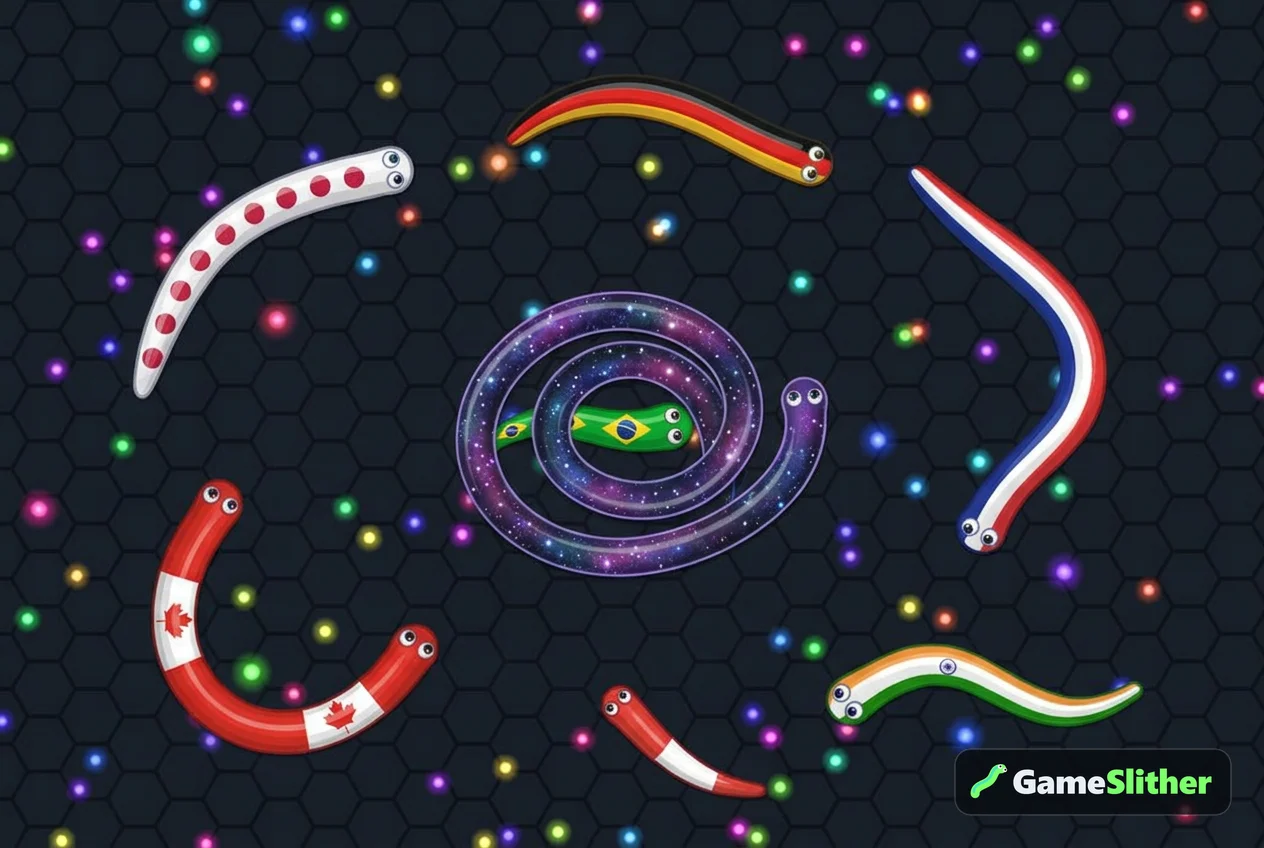
On GameSlither, playing normally earns coins: +1 coin per 10 length you reach and +5 coins per snake you take down. Those coins have no money value — they only unlock cosmetics. There are six free snake skins available from the start (Classic with 12 colours, Neon Cyber, Golden Dragon, Rainbow Candy, Jungle Python and Galaxy), plus a shop of 23 country-flag skins at 500 coins each.
On top of that:
- Daily missions: 3 fresh tasks every day (play N games, defeat N snakes, reach a length, survive N minutes in one life) that pay coins the moment you finish them.
- Daily login reward: 20 coins on day 1 rising to 200 on day 7 of a streak, then the cycle restarts.
- Achievement skins you cannot buy at any price: Inferno (length 1,500 in one life), Frost (survive 10 minutes in one life), Shadow (5 kills in one life) and Aurora (log in 7 days in a row).
That last group matters. A skin you can only earn by playing well says something a purchased one never will. Here's how to unlock the achievement skins if you want to chase them.
Reason 6: They work on everything, with anyone
io games run in a browser, which means they run on a cheap laptop, an old tablet, a school Chromebook and a phone. No console, no graphics card, no storage space. GameSlither works on desktop, mobile and tablet browsers and is available in 11 languages.
That universality is what makes them a social default. You don't ask "what platform are you on?" — you send a link. GameSlither lets you create a private room and share its 4-character code or an invite link (?room=CODE), so a group can land in the same arena in under a minute. For ideas on what to do once you're all in there, try these tournament formats for one night.
io games vs traditional online games, side by side
| Typical io game | Typical downloaded online game | |
|---|---|---|
| Time to first match | Seconds | Minutes to hours |
| Install required | No | Yes |
| Account required | Usually no | Almost always |
| Match length | 30 seconds – 20 minutes | 15–45 minutes, fixed |
| Leaving mid-match | Fine, no penalty | Lets the team down |
| Learning the rules | One match | Tutorial plus practice |
| Device needed | Any browser | Specific hardware |
| Cost to start | Free | Free to paid, plus storage |
Neither column is "better". They serve different moods. The io column simply has far fewer reasons to say no — and that is the whole story of the genre's popularity.
The takeaway
So, why are io games so popular? Because they removed every obstacle between a person and a multiplayer match: no download, no account, no cost, no commitment, no complicated rules. What's left is pure competition against real opponents, in a tab you can close at any moment.
The only way to really feel it is to try one. Open GameSlither and jump into a room — you'll be playing in about ten seconds, and you'll know by the end of your first match whether the genre is for you.
Frequently asked questions
What does the "io" in io games actually mean?
It comes from the .io web address ending that several early browser multiplayer hits used. It was never an official genre name — players simply started calling any simple, instant-play browser multiplayer game an "io game".
Are io games free to play?
The vast majority are completely free, funded by ads or optional cosmetics. GameSlither is free to play with no download and no sign-up, and its coins only unlock skins — they have no money value.
Do io games have real players or just bots?
Both, usually. GameSlither public rooms hold about 40 snakes made up of real players plus AI snakes that step aside as more people join, up to 50 players per room, so the arena never feels empty.
Can I play io games with my friends specifically?
Yes, if the game supports private rooms. On GameSlither you create a room and share its 4-character code or an invite link so friends land in the same arena — see the room code guide.
Why are io games so addictive compared to other games?
Matches are short, deaths feel like your own fixable mistake, and you can restart instantly with no queue or penalty. That fast failure-and-retry loop makes "one more game" very hard to resist.