Games Where You Grow Bigger by Eating: How It Works

Contents
Games where you grow bigger by eating all run on the same engine underneath: you absorb something small, your character gains mass, and that mass changes both what you can do and what can kill you. The genre feels simple because the input is simple — move toward food — but the depth comes from a constant trade between growth speed and exposure. Understand that trade and you stop being food yourself.
What counts as a "grow by eating" game
The label covers more ground than most players assume. The shared ingredients are:
- A measurable size stat. Mass, length, radius, score — one number that goes up when you consume.
- Consumption as the only progression. No XP bars, no skill trees. You eat, you grow, and that is the whole character sheet.
- Size-gated interaction. Bigger things can do something to smaller things that smaller things cannot do back.
- A reset on death. You drop what you gathered and start again from the minimum.
That last point matters more than people think. In most games, losing a fight costs you time. In growth games, losing a fight costs you everything you ate, and usually hands it to whoever killed you. The genre is built on volatile wealth.
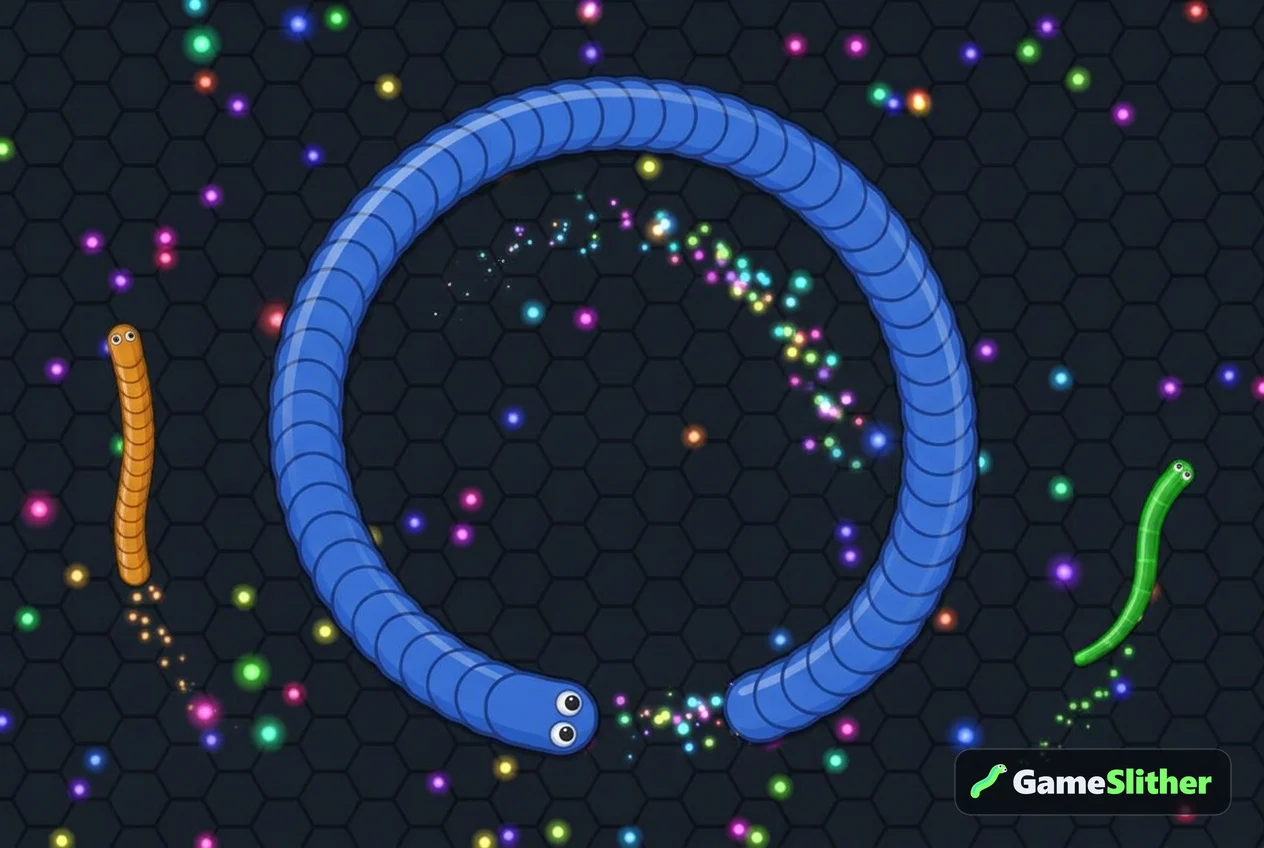
Blob games, fish-eat-fish games, hole-swallowing games and snake-style games like GameSlither all fit the definition. They diverge in exactly one place: how size converts into killing power.
The core loop, broken into four beats
Every session in these games cycles through the same four beats. Veterans recognise which beat they are in; beginners blur them together and die in the transition.
- Harvest. You are small, nobody cares about you, and food is abundant relative to your size. Pure efficiency phase.
- Threaten. You are now big enough that your presence changes other players' routes. You start earning kills passively, just by existing in their way.
- Risk. Growth slows because your size outpaces the food supply. The only fast growth left is other players' remains.
- Cash out or crash. Either you bank the run — a leaderboard spot, a personal record, a mission completed — or you overreach and feed the map.
The skill of the genre is knowing when beat 3 arrives. Most players stay in harvest mode too long and get farmed, or they jump to risk mode at a size that cannot survive a bad read.
Four families of growth games, compared
They look similar in a screenshot and play nothing alike.
| Family | How you grow | How you beat someone | Main risk | Skill ceiling |
|---|---|---|---|---|
| Blob / cell games | Absorb pellets and smaller blobs | Be meaningfully larger and touch them | Being split and eaten by a bigger blob | Splitting maths, feeding teammates |
| Fish-eat-fish games | Eat smaller fish, avoid bigger fish | Strict size tier dominance | Wandering into a higher tier | Low — mostly route learning |
| Hole / swallow games | Swallow objects to widen the hole | Swallow rival holes once larger | Timer pressure, slow starts | Medium — route efficiency |
| Snake / worm games | Eat pellets, grow length | Make them crash into your body | Trapping yourself with your own length | High — spacing, boost economy, baiting |
Snake-style games sit at the top of that table for one structural reason: size is not the win condition, it is the weapon's raw material. A huge blob eats a small blob automatically on contact. A huge snake can still lose to a tiny one, because the tiny snake only has to cut across its nose. That asymmetry is what keeps the genre interesting past the first hour.
Why length behaves like a wall, not armour
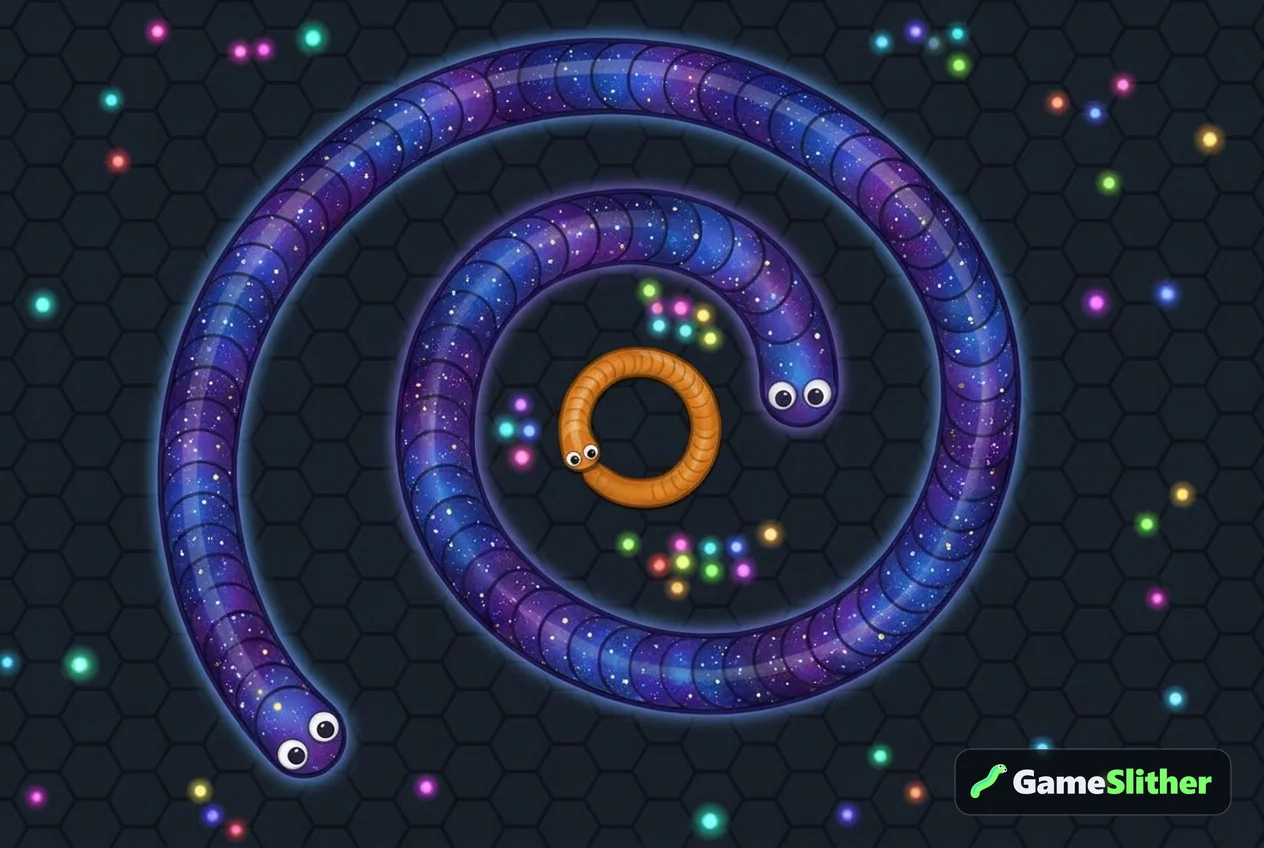
In snake-style games your body is terrain. Everything you have eaten becomes a solid line other players must respect, and that line follows you around whether you want it to or not.
This creates three effects worth internalising:
- Your kill power scales with reach, not bulk. A long snake can cut off a wide area in one sweep. A short one can only cover a narrow lane.
- Your death risk scales with your own geometry. Tight turns at high length are how experienced players kill themselves without any help.
- Your value as a target scales fastest of all. A long snake is a bank vault to anyone nearby, and in a busy room there is always someone nearby.
In GameSlither, public rooms hold roughly 40 snakes at once, a mix of real players and AI, scaling up to 50 players per room. That density means the "nobody noticed me" window closes quickly. Once you pass the midpoint of the leaderboard, assume you are being watched.
The size paradox
Here is the paradox every growth game shares: the bigger you are, the slower you grow and the more you lose per mistake. Pellet value stays flat while your appetite rises, so the marginal return on harvesting collapses. Meanwhile the cost of one bad turn goes from "20 seconds wasted" to "my entire run".
That is why high-level play in these games looks less aggressive, not more. Big players take fewer fights, but the fights they take are near-certainties.
The hidden layer: the mass economy
The part newcomers never see is that growth games are economies, and boosting is the interest rate.
In GameSlither, boosting (hold left click, Space, or the ⚡ button) burns length and drops pellets behind you. You are literally converting stored growth into speed, and feeding the map while you do it. Three consequences follow:
- Boost is a purchase, not a free action. Spend it on something that pays: a cut-off, an escape, or a sprint to a fresh pile of food.
- Chasers lose money. A long chase at full boost often costs the hunter more length than the kill is worth.
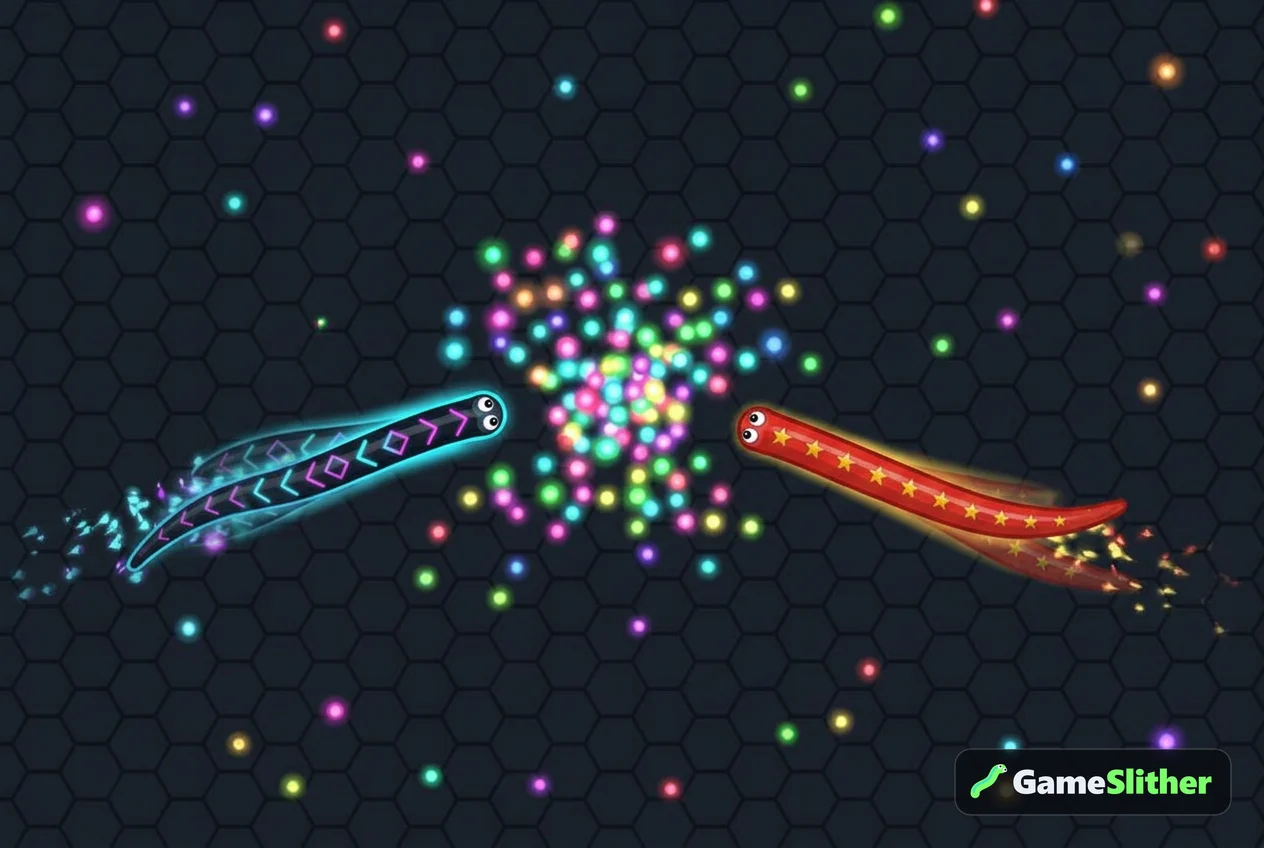
- Death is a payout to the room. When a snake dies it leaves a trail of pellets, which is why the fastest growth in the game is rarely found by hunting — it is found by being nearby when someone else's fight ends.
The AI snakes model this openly. GameSlither's bots come in three personalities: shy ones steer clear of bigger snakes, hunters try to cut off smaller ones, and gluttons sprint straight for the pellets a defeated snake left behind. That third personality exists because scavenging genuinely is the strongest economic move in the genre. If you want the full picture on why bots are there at all, we covered it in this breakdown.
Five rules that transfer across every growth game
These hold whether you are a blob, a fish or a snake.
- Grow at the edge of the crowd, not inside it. Food near the centre is contested; food two screens out is yours. Check the minimap before committing to an area.
- Never travel in a straight line for long. Predictable paths are how cut-offs land. Gentle, irregular curves cost you almost nothing and ruin other people's timing.
- Treat every big snake as a wall with a mood. Stay outside its turning radius and you are safe; drift inside it and you are the plan.
- Arrive second to every fight. Let two others collide, then collect. This single habit outperforms aggressive hunting in almost every session.
- Bank progress mentally. Decide in advance what the run is for — a record length, a mission, a leaderboard slot — and play tighter once you are close.
If you want these turned into a step-by-step routine for a single match, How to Grow Fast in Snake io Without Dying Early goes deeper on the opening minutes.
Why the genre works so well in a browser
Growth games need three things: instant input, a readable screen, and a short loss cycle. All three are cheap to deliver in a browser, which is why the format thrives there.
GameSlither leans into that. There is no download and no sign-up, it runs on desktop, mobile and tablet, and a death costs you nothing but the run. The scaffolding around the loop does the long-term work:
- A result screen after each death showing max length, kills, time alive, best rank and coins earned, plus a Share button that builds a result image.
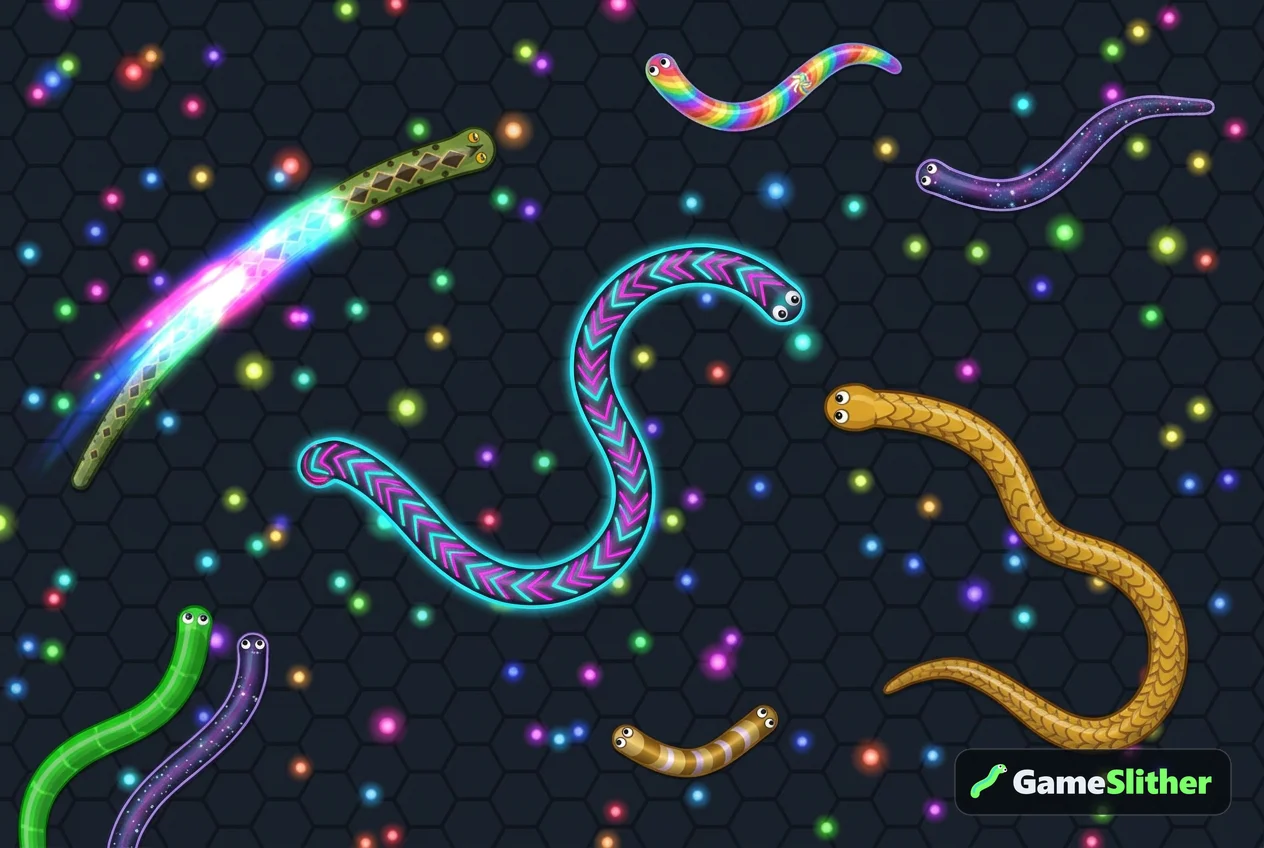
- Coins for playing — +1 for every 10 length reached and +5 per snake taken down — spendable on the Jungle Python (500) and Galaxy (700) skins, alongside the free Classic skin in 12 colours.
- Three fresh daily missions and a daily login reward that climbs from 20 to 200 coins across a seven-day streak.
- A weekly and all-time hall of fame for the longest snake in a single life.
- Private rooms with a 4-character code, if you would rather test these ideas against friends than strangers.
None of that changes the loop. It just gives the loop somewhere to accumulate.
Final word
Games where you grow bigger by eating reward patience far more than reflexes. Learn the mass economy, respect the size paradox, and let other people's mistakes fund your growth — that formula works in every corner of the genre. Pick a lane, start small, and see how far you can stretch a single life over at GameSlither.
Frequently asked questions
What is the genre called when you eat things to grow bigger?
There is no single official name, but players usually call them growth games, "eat and grow" games, or io games, after the .io domains the early browser hits used. Snake-style titles, blob games and hole-swallowing games all belong to the same family.
Does being bigger always mean you win in these games?
No, and that is the genre's best twist. In blob and fish games size usually decides contact fights, but in snake-style games like GameSlither a tiny snake can still kill the leader by making it crash, so length is a weapon rather than armour.
What is the fastest way to grow in a snake-style game?
Collect the pellets left behind when other snakes die. Harvesting loose food is steady but slow, while arriving just after a collision gives you a dense cluster in one sweep — which is exactly what the glutton-personality bots in GameSlither are built to do.
Does boosting make you grow faster?
The opposite. In GameSlither, boosting costs length and drops pellets behind you, so treat it as a purchase: spend it on escapes, cut-offs or a sprint to fresh food, not on casual travel.
Do I need an account to play a game where you grow by eating?
Not for GameSlither — there is no download and no sign-up, and it runs in desktop, mobile and tablet browsers. A recovery code lets you restore your coins and skins on another device or after clearing browser data.