How to Get a High Score in Snake Game: 8 Habits
Contents
- What a "High Score" Actually Measures
- Habits 1–3: Build a Base That Doesn't Collapse
- Habits 4–6: Turn Other Snakes Into Your Food Supply
- Habits 7–8: Endgame Discipline and Honest Review
- Average Player vs High-Score Player: Same Situations, Different Choices
- A 20-Minute Practice Routine That Moves the Number
- Putting It Together
Getting a high score in a snake game has far less to do with reflexes than most players assume. The snakes that finish at the top of the leaderboard repeat the same small set of habits every single match: a slow, boring opening, disciplined boost spending, and a plan for turning other snakes' deaths into their own length. This guide breaks down the eight habits that reliably raise your personal best in GameSlither — and the instincts you need to unlearn to get there.
What a "High Score" Actually Measures
Before you optimise anything, be clear about the number you are chasing. In a modern snake game the headline score is maximum length reached in a single life. That is the figure the hall of fame tracks in GameSlither, both for the weekly board (which resets every Monday) and the all-time board.
Everything else on the result screen is supporting evidence:
- Max length — the score itself.
- Kills — a tool for farming length, not a score in its own right.
- Time alive — the clearest proxy for how disciplined your run was.
- Best rank — how high you climbed in the live leaderboard during the match.
- Coins earned — +1 per 10 length reached and +5 per snake you take down, so a long run pays twice.
This matters because the fastest way to a big number and the most exciting way to play are different things. Chasing kills produces highlight moments and short lives. Chasing length produces unremarkable, quiet matches that end with a personal best. If you want the number, you have to be willing to play the boring version first. If you are new to the genre entirely, run through the how to play basics before you start optimising.
Pick a target before you spawn
A vague intention ("get big this time") collapses the moment a smaller snake crosses in front of you. A concrete target survives temptation. Useful targets include:
- Beat your current personal best length by 100.
- Survive 10 minutes in one life (this also unlocks the Frost achievement skin).
- Reach length 1,500 in one life (Inferno skin territory).
- Take down 5 snakes in one life without dying (Shadow skin).
Notice that these goals pull in different directions. A 10-minute survival run and a 5-kill aggression run are almost opposite strategies. Decide which one you are doing before the match starts, not halfway through it. More on those targets in our guide to unlocking achievement skins.
Habits 1–3: Build a Base That Doesn't Collapse
Most runs die in the first two minutes. Not because the player was outplayed, but because they started competing before they had anything to compete with.
Habit 1 — Treat the first 90 seconds as setup, not competition
You spawn tiny. A tiny snake has no trapping power, no ability to cut anyone off, and almost nothing to absorb a mistake. The correct behaviour for the opening is simple and unglamorous: find quiet space, eat loose pellets, and ignore everything happening elsewhere.
Concretely:
- Glance at the minimap the second you spawn. Dense clusters of dots mean fights, which means big snakes and dropped pellets you are too small to safely claim.
- Move away from the densest area, not toward it.
- Eat the scattered pellets in your immediate neighbourhood with gentle, wide turns.
- Do not boost. There is nothing in the first 90 seconds worth boosting for.
A public room in GameSlither holds around 40 snakes at any moment, a mix of real players and AI, so there is always a crowd somewhere. There is also always empty map. Early on, empty map is worth more to you than food.
Habit 2 — Spend boost like currency, not reflex
This is the single biggest difference between a 300-length player and a 1,500-length player. Boosting burns your own length and drops pellets behind you — which means panic-boosting literally feeds the snake chasing you while shrinking the score you came for.
Use a three-reason rule. Boost only when one of these is true:
- You are closing a cut-off you have already set up. The angle exists; boost finishes it.
- You are escaping a trap that is genuinely closing. Not "a snake is nearby" — an actual shrinking gap.
- You are claiming a pellet pile before someone else gets there. The food has to be worth more than the boost cost.
Everything else — boosting to travel, boosting out of excitement, boosting because another snake boosted at you from a safe distance — is score you are throwing away. Train yourself to notice the urge and release the button. On GameSlither you can boost with left click, Space, or the ⚡ button on touch screens, and the habit is identical on all three.
Habit 3 — Never enter a space with only one exit
Snake deaths are collisions: you die when your head touches another snake's body. That means survival is a geometry problem, not a speed problem. Before you commit to any direction, ask whether you could still turn out of it if a big snake appeared in front of you.
The three classic one-exit spaces:
- The narrow gap between a long snake's body and the map wall.
- The inside of a curve another snake is drawing around you.
- The middle of a scrum where four or five snakes are converging on the same pile.
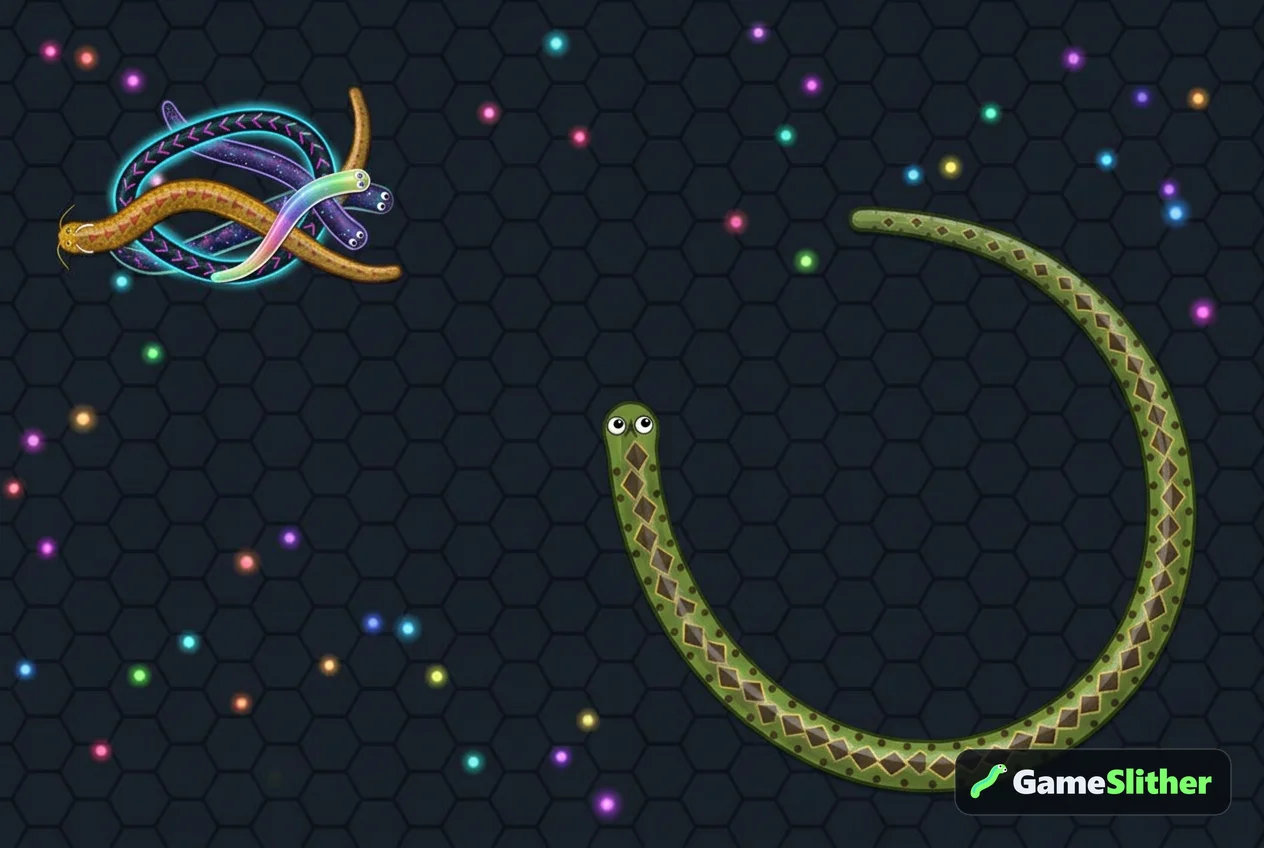
Keep at least two open angles at all times and your death rate drops immediately. Your own tail is not a hazard, so wide self-loops are a free safety tool — we explain the exact rules in can you hit your own tail in snake io.
Habits 4–6: Turn Other Snakes Into Your Food Supply
Loose pellets alone will not carry you to a top-ten run. At some point you need to eat what dies. The question is how you do it without becoming the next pile.
Habit 4 — Hunt the pile, not the snake
When a snake dies it leaves a dense trail of pellets — far more food than you will find grazing. That pile is the real prize, and you do not need to have caused the death to eat it.
The professional way to take a pile:
- Approach from the outside edge and eat along the perimeter, sweeping inward only when the area is clear.
- Keep your head pointed along the pile rather than into the middle of it, so you can peel away instantly.
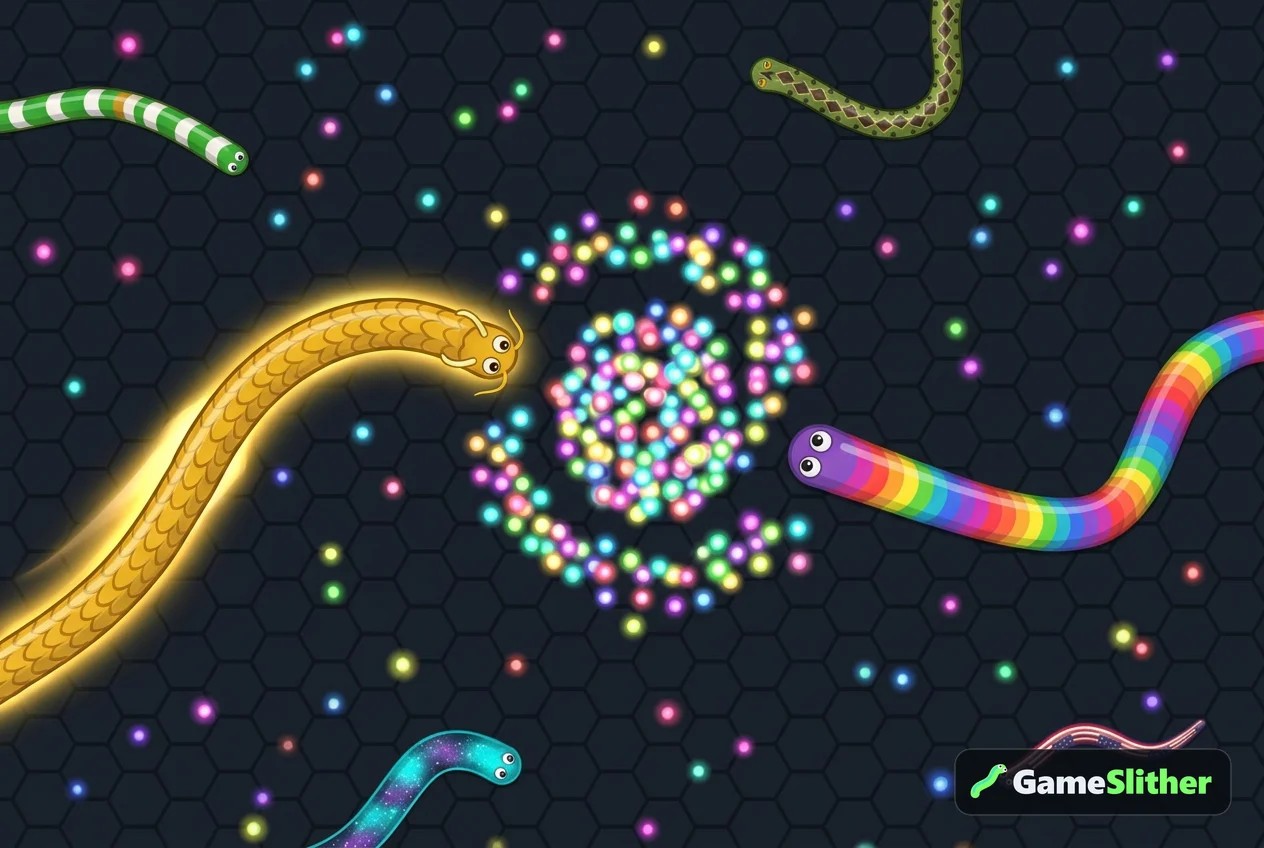
- Expect company. Glutton-type AI snakes rush straight at fresh pellets, and human players do the same.
- If two large snakes are already circling the pile, skip it. A 200-length gain is not worth a coin-flip collision.
Patience here is worth more than speed. The outer third of a big pile is usually uncontested while everyone else fights over the centre.
Habit 5 — Read who you are actually fighting
GameSlither rooms mix real players with AI snakes that step aside as more humans join, up to 50 players per room. The AI comes in three personalities, and each one telegraphs itself:
| Snake type | Telltale behaviour | How to play against it |
|---|---|---|
| Shy AI | Veers away whenever you grow larger or approach | Easy to push off food; not worth chasing for a kill |
| Hunter AI | Angles ahead of smaller snakes, tries to cut them off | Turn early and wide; never try to out-sprint the cut |
| Glutton AI | Beelines for fresh death piles, ignores danger | Let it crash into the scrum, then eat what it leaves |
| Human player | Hesitates, over-boosts, makes irregular turns | Most dangerous when small and reckless, most predictable when large |
The practical takeaway: do not spend your boost on snakes that are avoiding you anyway, and do not panic when something charges a pile — that is often a glutton about to solve your problem for you. For a deeper breakdown, see snake game bots vs real players.
Habit 6 — Learn one trap and execute it cleanly
Players who try to learn every manoeuvre at once execute all of them badly. Pick one, drill it, and only add a second when the first is automatic.
The sidewipe (best first trap). You travel alongside a smaller snake on a roughly parallel course, then cut sharply across the front of its head. The opponent runs into your body. It needs no circling, costs little boost, and leaves you with an escape route the whole time. Fail condition: committing too far ahead, so the target simply turns behind you.
The coil (second trap). You circle a chaser with a wide loop that gradually tightens. It demands real length and real patience, and the mistake that kills people is tightening so aggressively that they corner themselves against a wall or a third snake. Only coil when you are comfortably longer than the target and you have clear map on the outside of your loop.
The kills do more than feed you. Each takedown pays 5 coins instantly, which stacks with the +1 per 10 length you are already earning — useful if you are saving toward a new snake skin.
Habits 7–8: Endgame Discipline and Honest Review
Long snakes rarely die to brilliant plays. They die to boredom, overconfidence, and the belief that size equals safety.
Habit 7 — Change your risk profile once you are big
A long snake handles differently. Your turning circle is effectively larger, your body occupies more of the space you need to escape into, and every other snake on the map now sees you as a jackpot. Adjust accordingly:
- Widen every turn. Sharp cuts that worked at length 200 will clip your own path at 1,200.
- Leave the crowd. Once you are clearly on the leaderboard, the centre of the map is a liability. Graze the quieter two-thirds of the arena.
- Stop taking optional fights. At 1,000+ length, a kill adds a pile you might not even finish eating. A collision ends everything.
- Check the minimap on a rhythm. Every few seconds, not only when something scares you. You want to see the crowd forming before it reaches you.
- Watch your own stamina. Long runs cost attention. If you notice your turns getting lazy, you are already in the dangerous phase.
If you are curious how long these runs actually take, we timed the climb in how long to reach 1000 length.
Habit 8 — Read the result screen like a replay
Every GameSlither run ends with a breakdown: max length, kills, time alive, best rank and coins earned. Most players tap through it. High scorers use it as a two-question debrief:
- What killed me? Almost every death falls into three buckets: head-on contact with a bigger snake, boosting into a body you did not see, or being encircled with no exit. Name the bucket out loud.
- Where did my curve flatten? If your length stalled for minutes before the death, the problem was food strategy, not safety. If you died early at a decent length, the problem was risk management.
Track it over five runs and a pattern appears fast. Players who die to encirclement are playing too close to the crowd. Players who die boosting are breaking Habit 2. Players who stall out are grazing loose pellets instead of claiming piles. You can also hit Share to save a result image — a surprisingly effective motivator when you are chasing your own previous best.
Average Player vs High-Score Player: Same Situations, Different Choices
| Situation | What most players do | What high scorers do |
|---|---|---|
| First 30 seconds | Head toward the action | Head toward empty map |
| A snake appears behind you | Boost away in a straight line | Turn wide, keep two exits, don't spend length |
| Fresh death pile with three snakes on it | Dive for the centre | Eat the outer edge, leave when it crowds |
| Smaller snake crosses your path | Chase it across the map | Take the sidewipe only if the angle already exists |
| Reaching length 1,000 | Start hunting for kills | Move to quiet map and protect the score |
| Dying at length 800 | Instantly respawn | Name the cause, then respawn |
| Boost usage | Constant, reflexive | Three-reason rule, often unused for minutes |
None of these choices require better aim or faster hands. They require deciding in advance what you will do, so that the decision is already made when the moment arrives.
A 20-Minute Practice Routine That Moves the Number
Random play produces random results. Three structured runs produce measurable improvement.
Run 1 — No boost at all (about 6 minutes). Play an entire life without pressing boost once. It feels awful and it works. You will discover how many of your deaths were self-inflicted and how much length you normally burn on nothing. Target: beat 5 minutes alive.
Run 2 — Boost budget (about 7 minutes). Allow yourself five boosts for the whole life. Each one has to satisfy the three-reason rule. This builds the habit of evaluating before spending.
Run 3 — Free play with one objective (about 7 minutes). Apply everything, but hold one goal: either beat your best length or land 5 takedowns. Not both.
Two extra ways to accelerate:
- Use private rooms for trap drills. Create a room, share the 4-character code or the invite link with a friend, and practise sidewipes and coils with zero leaderboard pressure. It is the closest thing to a training mode.
- Let daily missions guide your sessions. The three daily missions (play N games, defeat N snakes, reach a length, survive N minutes in one life) pay coins instantly and happen to align with exactly the skills you are drilling. The login streak adds 20 up to 200 coins across days 1–7, which funds skins without changing anything about how you play.
For more on the growth curve specifically, our guide on how to grow fast without dying early pairs well with this routine.
Putting It Together
If you remember nothing else about how to get a high score in snake game matches, remember this: your score is built in the quiet minutes, not the loud ones. A slow opening, a boost budget, piles instead of chases, one clean trap, and a disciplined endgame will outscore raw aggression almost every time — and the result screen will tell you exactly which habit slipped when it doesn't.
Pick one habit from this list, run three matches with it, then add the next. Open GameSlither in your browser — no download, no sign-up — and see how far a boring, deliberate run gets you compared to your usual one.
Frequently asked questions
What is a good high score in a snake game?
For most players, breaking 1,000 length in a single life is a solid benchmark, and 1,500 is a serious run (it also unlocks the Inferno skin in GameSlither). The real measure is beating your own previous best on the result screen.
Does boosting help you get a higher score?
Only situationally. Boosting costs your own length and drops pellets behind you, so constant boosting shrinks your score and feeds your pursuers — save it for finishing a cut-off, escaping a closing trap, or claiming a pellet pile first.
Do kills increase your score in snake io games?
Kills do not directly raise your length score, but the pellet pile a defeated snake leaves behind is the fastest food source in the game, and each takedown pays 5 coins in GameSlither. Treat kills as a means to length, not the goal.
How long does it take to reach 1,000 length?
It depends heavily on how much boost you spend and how often you reach death piles, but a disciplined run usually gets there in several minutes of uninterrupted play. We break the timing down in how long to reach 1000 length.
Can you get a high score playing on a phone?
Yes. GameSlither runs in mobile and tablet browsers with touch steering and a dedicated ⚡ boost button, and the same habits apply — wide turns and boost discipline matter even more on a smaller screen.