Can You Hit Your Own Tail in Snake io? The Real Rules
Contents
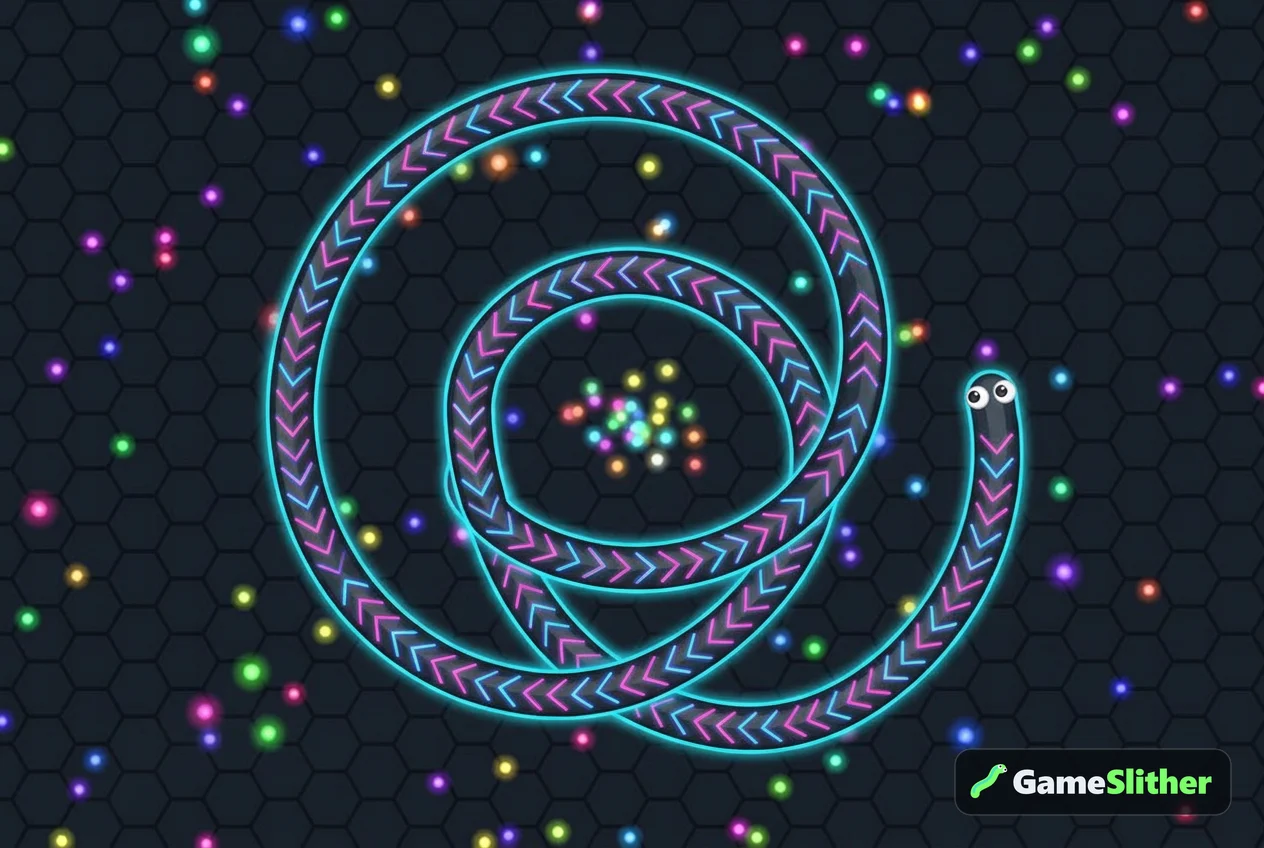
If you grew up on Nokia Snake, the first instinct you bring into a browser arena is to never, ever cross your own trail. Good news: in slither-style games — GameSlither included — your own body is not solid to you. You can loop, spiral and coil through your own tail as many times as you like; the only thing that ends your run is your head touching another snake's body.
That single rule change is the reason modern snake io games play nothing like the classic version, and the reason coiling is the single most profitable skill in the genre. Below, the full collision logic, a side-by-side comparison with classic Snake, and the tactics that only work because self-collision is off the table.
The short answer: your own tail is harmless
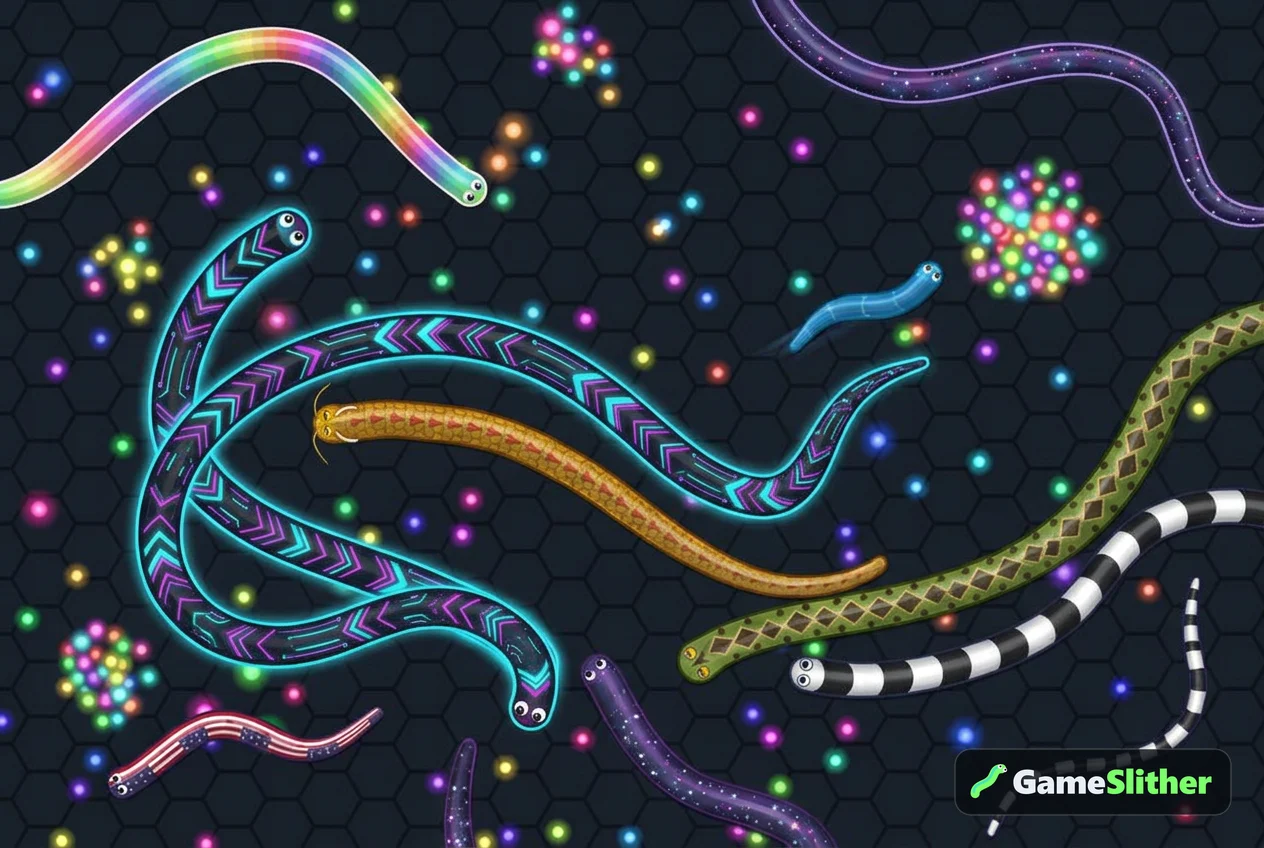
Ask "can you hit your own tail in snake io" in any lobby and the honest answer is no — not in the way you fear. Your snake's segments trail behind your head as a soft rope, not a wall. You can:
- Turn in a complete circle and pass straight through your own tail.
- Spiral inward until you're a tight coil of your own body.
- Reverse direction in a hairpin and brush across six of your own segments without a scratch.
There is no penalty, no length loss, no slowdown. The collision check that matters only fires when your head meets a segment belonging to a different snake — a real player or one of the AI snakes sharing the room.
This is why a 3,000-length snake can sit in a knot the size of a coin and still be perfectly safe. Its own 3,000 segments are furniture, not hazards. The how to play rundown covers the basics, but this is the detail that separates a nervous beginner from someone who controls space.
Why classic Snake and snake io games use opposite rules
Classic Snake was a single-player puzzle about self-management. You had no opponents, so the designers made you the obstacle: the longer you got, the smaller your safe area became, and the game ended when you ran out of room. Length was a punishment disguised as a reward.
Snake io games flipped that. The opponents are other snakes, so length needs to be a genuine advantage — which means your own body has to stop being a liability. If self-collision were enabled with 40 snakes on the map, nobody would ever reach a serious score, and the whole "wrap around a smaller snake" fantasy would be impossible.
| Rule | Classic Snake (Nokia / Google) | Snake io style (GameSlither) |
|---|---|---|
| Hitting your own tail | Instant game over | Nothing happens — you pass through |
| Main cause of death | Yourself | Your head hitting another snake's body |
| Growth | Fixed food items, fixed grid | Glowing pellets scattered across the arena |
| Opponents | None | Up to 50 players per room plus AI snakes |
| Getting longer | Makes survival harder | Makes you more dangerous |
| Speed boost | Usually none | Hold left click / Space / ⚡ — costs length |
| After death | Score screen | Result screen with max length, kills, time alive, rank and coins |
For a longer look at how the genre evolved out of those grid-based roots, see the history of the snake game.
What actually kills you in a snake io game
Since your tail is off the suspect list, here is the real one. You die when:
- Your head touches another snake's body. Any segment, anywhere along it, from head to tail tip. Size is irrelevant — a 200-length rookie's body kills a 4,000-length leader just as efficiently.
- You get cut off mid-boost. A hunter crosses in front of your head while you're travelling at boost speed and you simply don't have the turning radius to avoid the wall of segments.
- You trap yourself against someone else's coil. This is the closest thing to "hitting your own tail": you spiral inward, an enemy wraps the outside of your spiral, and now the only exit is through their body.
Notice who has the advantage in every one of those. The snake that doesn't move its head into danger survives. That's the whole game: you never kill anyone directly, you just make them run into you. Our breakdown of what happens when you die covers the aftermath — including the pellet trail your corpse leaves for everyone else.
Head-on meetings are the one coin flip
When two heads collide at almost the same instant, both snakes can go down. Veterans avoid head-on angles entirely unless they're clearly faster and can curve across the opponent's nose rather than into it. Your length means nothing in a head-to-head; geometry does.
Coiling: how to weaponise self-overlap
Because your own segments can't hurt you, you can build structures with your body. These are the three that pay.
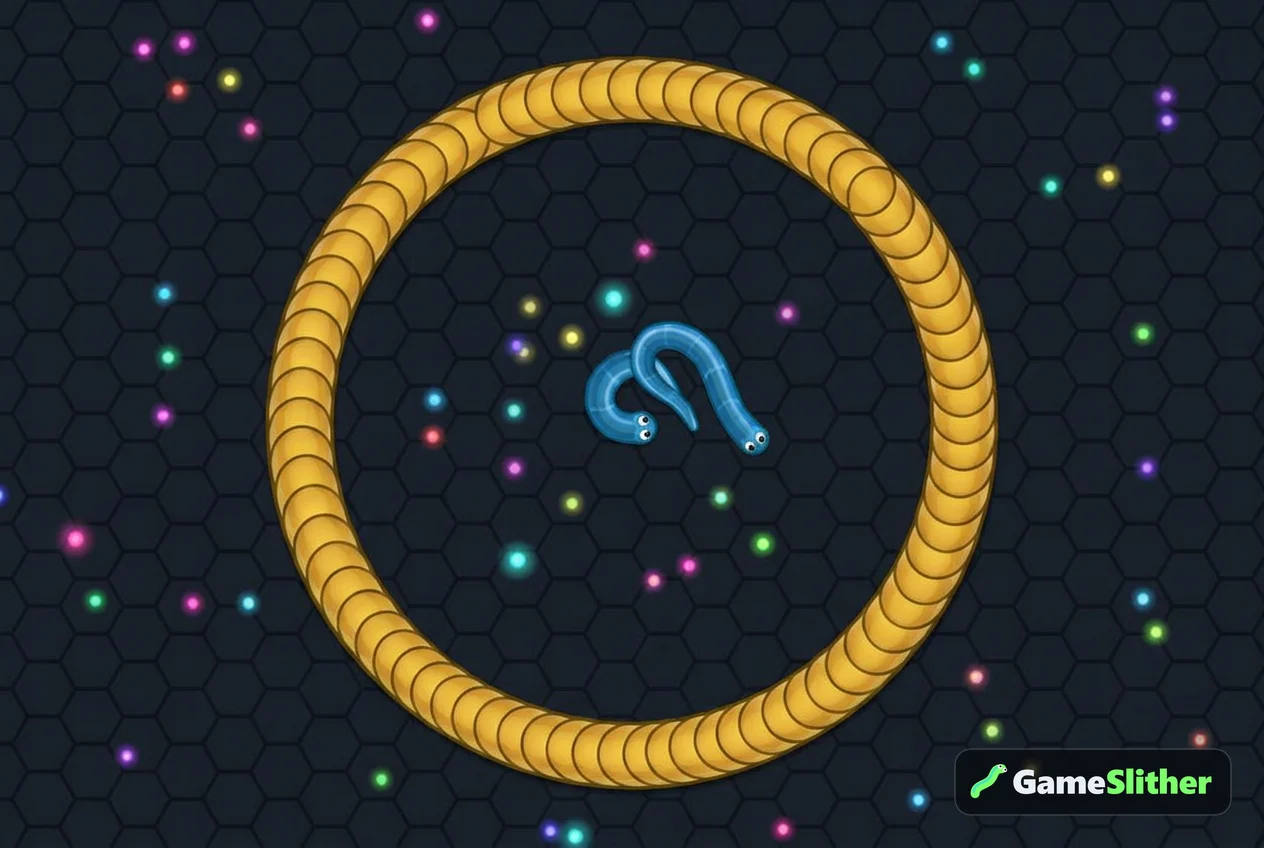
The circle trap. Spot a smaller snake, swing wide around it and close the loop. Your body becomes a fence they cannot cross — any direction they pick ends in your segments. Keep the circle slowly shrinking and they'll panic-boost into you. This is impossible in any game with self-collision.
The defensive knot. When three snakes are converging on you, stop running and coil tightly on the spot. A dense knot has no approach angle: any snake that tries to cut you off has to bring its own head near your mass, and the moment it clips you, it dies and you eat the remains. Boost in small arcs, don't straighten out, and wait for them to lose patience.
The lane squeeze. Run parallel to a bigger snake, then curl your body back across your own path to form a narrowing corridor. Snakes chasing your tail end up funnelled into a dead end made of your own segments.
All three depend on tempo. Coiling costs you boost length, so decide early whether a target is worth the investment — the maths behind that trade-off is in our guide to boosting without losing all your length.
The indirect ways your own tail does cost you
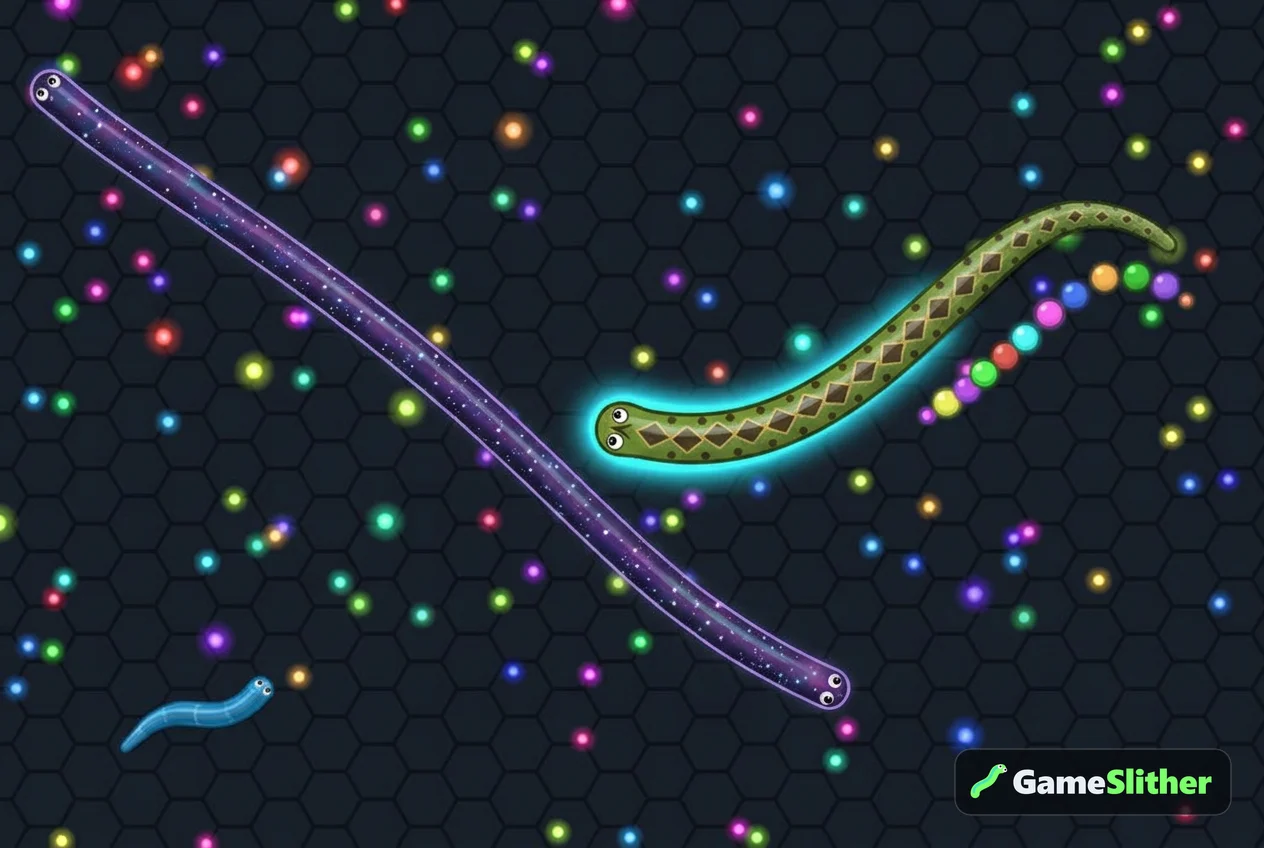
Self-collision is off, but your body still shapes the board, and careless shapes get punished.
- You bury your own escape route. A tight coil feels safe until a bigger snake parks on the outside. You can swim through your own segments, but you can't swim through theirs — and the only gap left is the one they're sitting in.
- You hide pellets under yourself. Your segments are drawn over the field, so a dense knot makes it hard to read what's underneath. Loosen the coil occasionally to check your surroundings.
- You telegraph your intention. A visible circle forming on the minimap is a broadcast: "I'm committing to a trap here." Opportunists will come to collect whichever of you loses.
- You lose length while circling. Holding boost to close a trap drops pellets behind you. Fail the kill twice in a row and you've donated 15% of your snake to the room for nothing.
The rule of thumb veterans use: never coil in a space you cannot leave in one smooth arc. If your exit requires a hairpin at full speed, you've built a cage for yourself, not for your target.
Practising the coil without feeding the leaderboard
The safest place to learn self-overlap is a room where mistakes are cheap.
- Start in a public room and coil on empty ground. No target, no pressure — just loop through your own tail repeatedly until the fear wears off and the turning radius becomes muscle memory.
- Practise on AI snakes. Shy bots break away from circles, hunters charge into them, gluttons ignore everything to reach pellets. Reading which one you've trapped tells you whether to tighten or abandon — our guide on spotting bots versus real players explains the tells.
- Run drills with friends. Create a private room, share the 4-character code and take turns being the circler and the trapped snake. Ten minutes of this teaches more than an hour of solo play — see how to set up a private room.
- Review the result screen. Max length, kills, time alive and best rank together tell you whether your coils are converting. Lots of time alive with zero kills means your traps are too loose.
If you want more all-round habits to pair with coiling, the leaderboard tips guide is the natural next read.
The takeaway
So, can you hit your own tail in snake io? No — and once that sinks in, the whole game opens up. Your body stops being a timer counting down to a mistake and becomes a tool: a fence, a shield, a funnel. The snakes topping the hall of fame aren't the ones who avoid their own trail; they're the ones who build with it.
Go test it yourself. Play GameSlither free in your browser — no download, no sign-up — and spend your first run doing nothing but loops through your own tail until the old Nokia reflex finally lets go.
Frequently asked questions
Can you hit your own tail in snake io games?
No. In slither-style games such as GameSlither your own segments pass harmlessly through your head, so you can coil and loop as much as you want. Only contact between your head and another snake's body ends your run.
Why can you hit your own tail in classic Snake but not in snake io?
Classic Snake was single-player, so your own body had to act as the obstacle that eventually ended the game. Snake io games have up to 50 players plus AI snakes providing the danger, so length is made an advantage instead of a punishment.
What is coiling and why does it work?
Coiling means wrapping your body in a circle or knot around a smaller snake so every escape direction runs into your segments. It only works because self-collision is disabled — you can cross your own tail freely while your opponent cannot.
Does coiling cost you anything?
Indirectly, yes. Closing a trap usually means holding boost, and boosting drops pellets and shortens you, so a failed coil hands free food to everyone nearby. See the boosting guide for the trade-off.
What is the most common way players actually die?
Moving their head into another snake's body while boosting, usually after a hunter cuts across their path. At boost speed your turning radius widens, so cutting the throttle early is often safer than trying to out-turn the trap.