History of the Snake Game: From Nokia to the Browser

Contents
- What Is a "Snake Game"? A Plain-English Definition
- The Arcade Ancestors: The 1970s and 1980s
- 1997: Nokia Puts Snake in Every Pocket
- The Browser Years: Flash, Java and Google's Snake
- 2015–2016: The .io Wave Turns Snake Into a Multiplayer Game
- Four Generations of Snake Games, Side by Side
- Where Snake Games Are Today
- The Story Continues in Your Browser Tab
The history of the snake game stretches from a 1976 arcade cabinet, through the Nokia phones that sat in millions of pockets in the late 1990s, all the way to multiplayer browser arenas you can open in a single click today. Across nearly fifty years the core idea has barely changed: steer a line that never stops moving, eat to grow longer, and never crash. This guide walks through that journey step by step, in plain language, even if you have never played a snake game in your life.
What Is a "Snake Game"? A Plain-English Definition
Before the history, the rules. A snake game is any game where you control a long, thin shape that:
- moves forward constantly — you choose the direction, not whether to stop;
- grows longer every time it eats something (a dot, an apple, a glowing pellet);
- dies on impact — hitting a wall, your own tail, or another player ends the run;
- gets harder as it grows, because your own body becomes the biggest obstacle on the screen.
That last point is the clever bit, and it is why the genre survived every change in technology. Success makes the game more dangerous. No other mechanic is needed.
Over the decades, three different "death rules" have dominated: crashing into the screen edge (early arcade and phone versions), crashing into your own tail (the classic single-player formula), and crashing head-first into another player's body (the modern multiplayer formula).
The Arcade Ancestors: The 1970s and 1980s
Most historians point to Blockade, released by Gremlin in 1976, as the first recognisable ancestor. Two players each steered a dot that left a solid wall behind it, and the loser was whoever ran into a wall first. There was no food and no growing — the trail simply never stopped expanding — but the DNA is unmistakable.
Blockade was cloned quickly and widely, and over the following years home computers and mainframes filled up with versions under names like Worm, Snake and Nibbles. The single-player twist — add food, make the body grow only when you eat — turned a duel into a solo endurance test. Arcade cabinets such as Nibbler (1982) brought that version to coin-op machines.
By the early 1990s the genre was so standard that Microsoft shipped a version called Nibbles with MS-DOS, written in QBasic. Snake had become the "hello world" of game programming: simple enough for a beginner to build, satisfying enough that people kept playing it.
1997: Nokia Puts Snake in Every Pocket
The moment that made snake a household name came in 1997, when Nokia preinstalled a version called Snake on the Nokia 6110. It was designed by Nokia engineer Taneli Armanto, and it ran on a monochrome screen barely bigger than a postage stamp.
Why did this one version matter so much?
- It was already there. No shop, no download, no installation — you just opened the menu.
- It fitted the hardware perfectly. A handful of pixels and four direction keys were enough.
- It filled dead time. Bus stops, queues, waiting rooms. Sessions lasted a minute.
- Everyone had the same game. Comparing high scores worked because the game was identical on every handset.
Snake II, which arrived on phones such as the Nokia 3310 in 2000, added mazes, new food types and a two-player link mode. For an entire generation, "snake game" simply meant "that game on my Nokia".

The Browser Years: Flash, Java and Google's Snake
As home internet spread, snake moved to the web. Flash and Java portals hosted thousands of remakes, often with new skins, mazes and speed settings. The appeal was the same as on the Nokia: open it, play immediately, no installation.
Google later added its own Snake — a small, polished single-player version that many people meet through a search result or the Google Play Store. It is a faithful descendant of the Nokia formula: one player, four directions, walls that kill. If you enjoy it but want other people on the screen, there are plenty of multiplayer alternatives to Google Snake that keep the same instant-play feel.
This era established the habit that still defines the genre today: a snake game should load in a browser tab in seconds, with no account and no download.
2015–2016: The .io Wave Turns Snake Into a Multiplayer Game
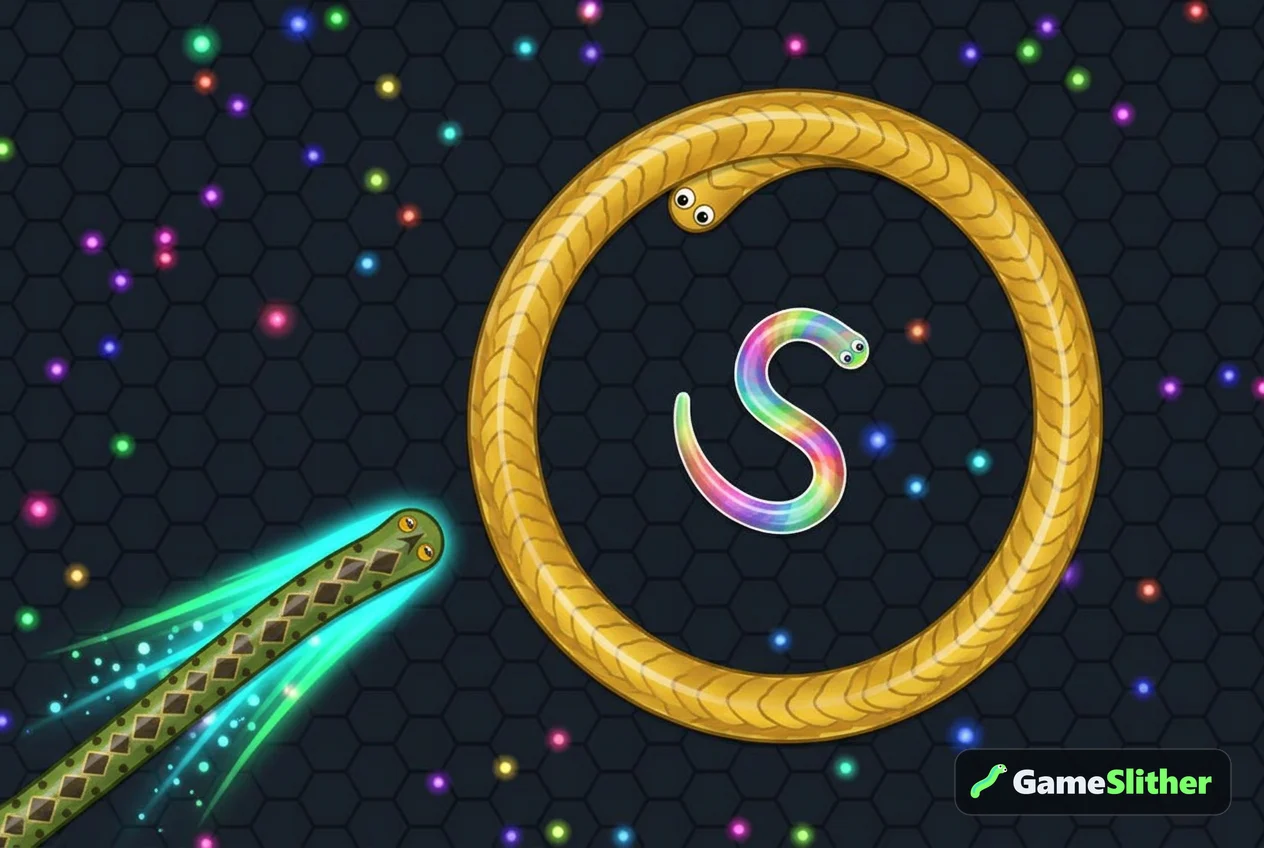
The biggest change in the history of the snake game arrived with the ".io" browser wave. Agar.io (2015) proved that a stripped-down, instantly playable browser game could hold dozens of real players in the same arena. A year later, Slither.io — made by Lowtech Studios — applied that idea to snakes, and the genre was reinvented.
Three rules changed everything:
- The walls disappeared. The arena became a large open map; other players became the obstacles.
- Your own tail stopped killing you. You can now coil around yourself freely, which opens up entirely new tactics.
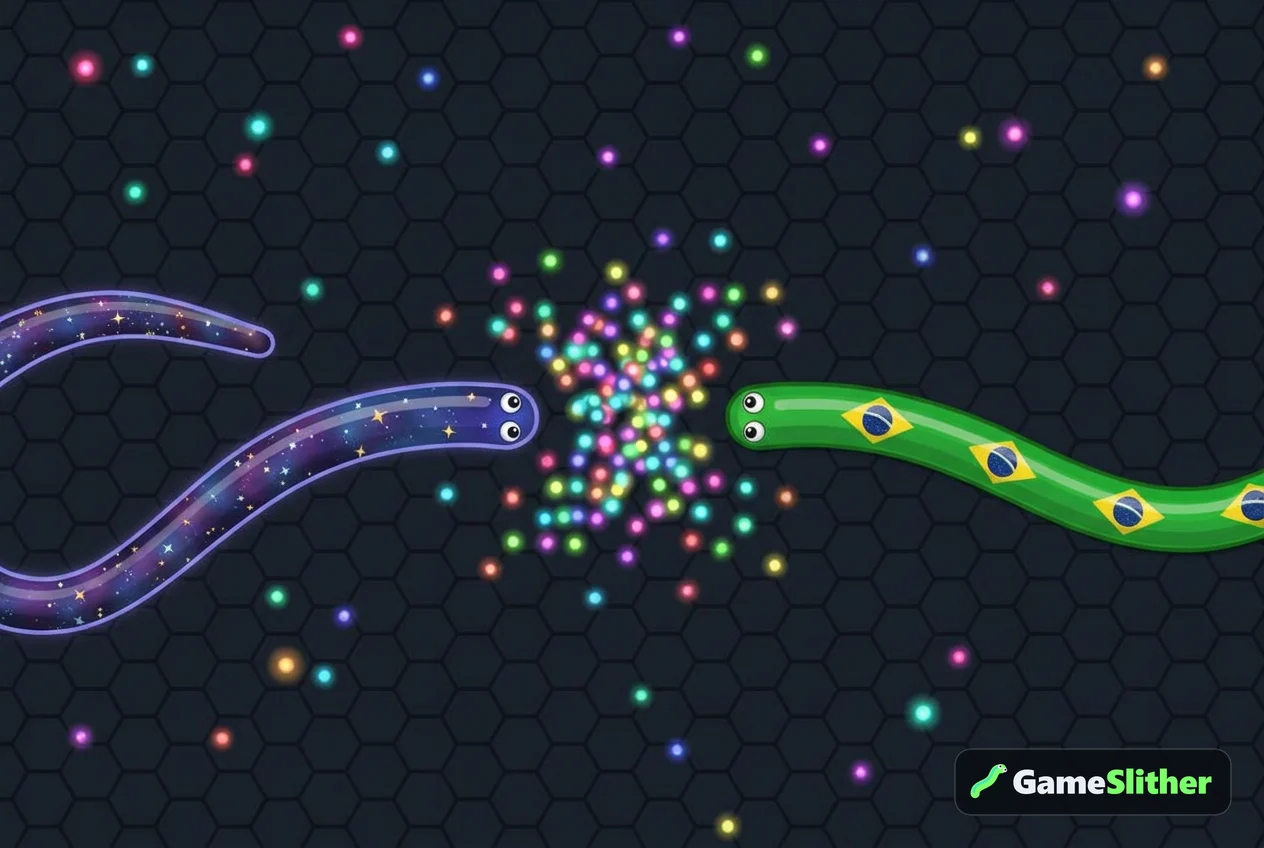
- Head-to-body collisions decide fights. If your head touches another snake's body, you die. If their head touches your body, they die.
Add a boost — a burst of speed that costs length and drops pellets behind you — and you have the modern formula: a game of nerve, angles and patience rather than reflex-only dodging.
Why You Don't "Bite" Other Snakes
This confuses almost every newcomer, so it is worth stating plainly: size does not win fights by itself. A tiny snake can defeat the longest snake on the leaderboard if the big one's head runs into its body. Being long gives you a bigger wall to trap people against, not immunity. Everything else — cutting people off, boxing them in, circling — follows from that one rule.
GameSlither is an independent game built in this modern style; it is not Slither.io and is not affiliated with Lowtech Studios. If you want the exact differences, the GameSlither vs Slither.io comparison lays them out.
Four Generations of Snake Games, Side by Side
| Era | Typical device | How you grow | How you lose | Players |
|---|---|---|---|---|
| Arcade ancestors (1976–1985) | Coin-op cabinet, home computer | Trail grows automatically or by eating dots | Hit a wall or a trail | 1–2 |
| Nokia era (1997–2000s) | Mobile phone keypad | Eat pixels on a tiny grid | Hit the screen edge or your own tail | 1 (2 via link cable) |
| Web/Flash era (2000s–2010s) | Desktop browser | Eat food in a maze | Hit a wall or your own tail | 1 |
| .io era (2015–today) | Browser on desktop, phone, tablet | Eat glowing pellets and leftovers from defeated snakes | Your head touches another snake's body | Dozens in one room |
Where Snake Games Are Today
A modern browser snake game keeps the 1997 promise — open and play — but wraps it in features the Nokia version could never have had. GameSlither is a good example of what the genre looks like now:
- Busy rooms. Public rooms always hold around 40 snakes: real players plus AI snakes that step aside as more humans join, up to 50 players per room.
- AI with personalities. Shy snakes avoid bigger ones, hunters try to cut off smaller snakes, and gluttons sprint toward the pellets a defeated snake leaves behind. Telling them apart is a skill in itself — see bots vs real players.
- Feedback everywhere. A live leaderboard, minimap, kill feed, explosion effects, sound (with a mute button) and vibration on phones.
- A result screen after every death showing max length, kills, time alive, best rank and coins earned, plus a Share button that builds a result image.
- Private rooms. Create a room and send friends the 4-character code or an invite link.
- Cosmetics without a paywall. Six free snake skins, 23 country-flag skins for 500 coins each, and four achievement skins you cannot buy at all — Inferno, Frost, Shadow and Aurora.
- Reasons to come back. Three daily missions, a login streak paying 20 up to 200 coins over seven days, and weekly plus all-time hall-of-fame rankings for the longest single life.
- No friction. Desktop, mobile and tablet browsers, 11 languages, no download, no sign-up, and a recovery code if you switch devices.
The Story Continues in Your Browser Tab
The history of the snake game is really the history of one very good idea being carried from arcade cabinets to monochrome phone screens to the open web — getting bigger, more social and more tactical each time, without ever losing its one-minute simplicity. The 1976 player and the 2026 player are doing the same thing: steering a growing line and trying not to crash.
The easiest way to feel that continuity is to play it. Open GameSlither in any browser, read the short how to play section if the modern rules are new to you, and take your snake into a 40-snake arena. No download, no account — just like 1997, only with a lot more company.
Frequently asked questions
When was the first snake game created?
The arcade game Blockade, released by Gremlin in 1976, is widely credited as the first recognisable ancestor of the genre. Two players steered dots that left solid trails, and the loser was whoever crashed first.
Who made the famous Nokia Snake game?
Snake was preinstalled on the Nokia 6110 in 1997 and was designed by Nokia engineer Taneli Armanto. A follow-up, Snake II, appeared on later handsets such as the Nokia 3310.
How are modern browser snake games different from classic Snake?
Classic Snake kills you when you hit a wall or your own tail. In modern .io-style games there are no walls, your own body is harmless, and you only die when your head touches another snake's body — so other players, not the arena, are the real danger.
Is GameSlither the same as Slither.io?
No. GameSlither is an independent browser game built in the same style and is not affiliated with Slither.io or Lowtech Studios. You can compare the two on the GameSlither vs Slither.io section.
Do I need to download anything to play a snake game today?
No. Browser snake games like GameSlither load straight in a tab on desktop, phone or tablet, with no installation and no sign-up required.