Why Do I Keep Dying in Slither io? 9 Real Causes
Contents
If you keep asking yourself why do I keep dying in slither io, the honest answer is this: almost every early death comes from a short list of repeatable mistakes, not from bad luck or "hackers". Beginners usually watch their own snake instead of the space in front of it, boost at the worst possible moment, and hang around the crowded middle of the map where ten snakes are fighting over the same pellets. Fix those habits one at a time and your average life goes from thirty seconds to several minutes.
Below are the nine real causes, explained slowly and with no assumed knowledge. Each one includes what it feels like from your side of the screen and exactly what to do instead.
The short answer before the long one
In a slither io style game your snake dies for one reason only: your head touched another snake's body. That is it. Your tail can be run over all day long and nothing happens. Other snakes can pass through your body and they are the ones who explode.
So every single death is a steering problem, a positioning problem, or an attention problem. Once you internalise that, the question changes from "why do I keep dying?" to "which of these three things did I get wrong?" — and that is a question you can actually answer and fix.
Here is the quick overview before we go through each cause in detail:
| Cause | What it feels like | Quick fix |
|---|---|---|
| Watching your own head | You never see the snake that kills you | Look one screen-length ahead of your head |
| Turning too sharply | You "died for no reason" | Make wide, lazy turns; never full circles |
| Panic boosting | You sprint straight into a wall of snake | Boost only with a planned exit |
| Living in the centre | Constant deaths under 60 seconds | Farm the quiet outer ring first |
| Ignoring the minimap | You hit the world edge | Glance at the minimap every 10–15 seconds |
| Diving into death piles | You die while eating free pellets | Eat the outer edge of the pile, not the middle |
| Fighting bigger snakes | You get encircled and trapped | Only pressure snakes smaller than you |
| Bad controls or device | Your snake lags behind your cursor | Close tabs, use a bigger surface, lower the window size |
| Playing while tired | Deaths pile up late in a session | Stop after a loss streak, come back later |
Causes 1–3: the steering mistakes
1. You stare at your own head
This is the single most common beginner habit. Your eyes lock onto the bright little head you control, because that is the part that feels like "you". The problem is that your head is already where it is — nothing useful ever happens there. Everything that kills you is arriving from somewhere else on the screen.
What to do instead: let your gaze sit roughly one snake-length in front of your head, and use your peripheral vision for everything else. It feels strange for about two matches, and then it feels normal. Drivers do exactly the same thing — nobody looks at their own bonnet.
A simple drill: for one full life, promise yourself you will not look directly at your head at all. You will steer worse for the first thirty seconds and better for the rest of the match.
2. You turn too sharply and steer into snakes you never saw
Good news first: in GameSlither your own body is harmless. Your head can cross your own tail as often as you like and nothing happens. So why do sharp turns still end so many lives?
Because a tight spin swings your head across the whole screen in a second or two, including the edges you were not watching. A snake that was just out of view slides in, your head meets its body halfway through the turn, and it feels like you "died for no reason".
The longer you get, the bigger this risk becomes. A 2,000-length snake spinning on the spot keeps its head stuck in one patch of the map while other snakes close in around the coil.
- Make wide arcs, not corners, so you can see where your head is going before it gets there.
- If you need to reverse direction, do it as a long U-turn in open space, not as a spin on the spot.
- Before any sharp turn, glance at the side you are turning towards.
3. You panic boost
Boosting (hold left click, the Space bar, or the ⚡ button on a phone) is the most misused tool in the game. Beginners use it as a panic button: something scary appears, they hold boost, and they rocket straight into the thing they were trying to escape. Boosting does not make you safer — it makes you faster at being wrong.
Two things to remember:
- Boost costs length. You shed mass and leave a trail of pellets behind you, which is a free meal for whoever is chasing you.
- Boost reduces your reaction time. At double speed you cover the same distance in half the time, so a gap that looked safe closes before you can respond.
Use boost in three situations only: to close a cut-off you have already planned, to escape a trap when you can see the exit, and to grab a large pellet cluster when the area is genuinely empty. Everything else is a donation to the next player.
Causes 4–6: the positioning mistakes
4. You spend your whole life in the middle of the map
The centre of any slither io style map is where the biggest snakes, the biggest pellet piles and the most deaths are. It is exciting. It is also the worst place to be when you are 50 length long and still learning to steer.
In a GameSlither public room there are around 40 snakes active at any time — a mix of real players and AI snakes — and a big share of them gravitate to the middle. The outer ring of the map has fewer snakes, fewer surprise encirclements, and still plenty of pellets.
A practical plan for your first three minutes:
- Spawn, then head outward rather than inward.
- Eat steadily in the quieter zone until you are comfortably mid-sized.
- Only then drift toward the busier areas, and leave again the moment you feel crowded.
If you want this broken down step by step, our guide on how to grow fast in snake io without dying early covers the whole early-game route.
5. You never look at the minimap
The minimap in the corner is not decoration. It tells you two things you cannot see from your own camera: where the crowd is, and where the world edge is. Running into the border is one of the most frustrating deaths there is, because nothing was chasing you — you simply ran out of world.
Build a habit of a quick glance every ten to fifteen seconds. It takes a fraction of a second and it prevents two whole categories of death:
- Edge deaths, because you can see when your dot is drifting toward the boundary.
- Ambush deaths, because a dense cluster of dots means a fight is happening and you should route around it.
6. You dive straight into a death pile
When a big snake dies it leaves behind a long, glowing line of pellets. It looks like free food. It is free food — but it is also the most dangerous square of map in the entire game for the next ten seconds, because every nearby snake is heading there at the same time.
The safe method:
- Approach from the outside edge of the pile, never across the middle.
- Eat along the edge in one direction so you always have open space on at least one side.
- Leave early. Getting 40% of a pile and surviving beats getting 90% and dying.
In GameSlither, some of the AI snakes are deliberately built as "gluttons" that rush straight at the pellets of a defeated snake. If you charge into the middle of a pile, you can be fairly sure you will not be alone there.
Causes 7–9: the habit and setup mistakes
7. You pick fights you cannot win
Cutting someone off — swinging your head in front of theirs so they crash into your side — is the core skill of the genre. It is also the fastest way to die when you try it on the wrong target.
A bigger snake has more body, which means more wall. When a long snake starts turning around you, it is not fleeing; it is building a circle. By the time you notice, the exit is already closed.
Simple rules:
- Only pressure snakes clearly smaller than you.
- If a snake is longer than you, keep it on one side of your screen and leave.
- Never follow a big snake into open space hoping for an opening. They are leading you.
There is a reward side to this too: in GameSlither you earn +5 coins per snake you take down and +1 coin for every 10 length you reach, so a long safe life is often worth more than a short aggressive one.
8. Your controls or device are working against you
Some deaths genuinely are not your fault in the moment — they are caused by setup. If your snake seems to lag half a second behind your cursor, you will lose fights you had already won in your head.
Things worth checking:
- Browser load. Close spare tabs and background video. A snake game is light, but a laptop running twenty tabs is not.
- Window size. A slightly smaller browser window can render more smoothly on older machines. See our browser games for low end laptops notes if your device struggles.
- Mouse travel space. If your mouse keeps hitting the edge of the mat, your turns get choppy. Give yourself room.
- Touch grip on tablets. Fat-finger deaths are real; our iPad controls guide explains how to hold the device so your thumb is not covering the thing that kills you.
If you are brand new to the controls altogether, the how to play section on the GameSlither home page walks through steering, boosting and the result screen in about a minute.
9. You keep playing when you are tired
This sounds soft, but it shows up clearly in the stats on the result screen. Look at your max length and time alive across a long session: most players have a clear peak and then a slow decline. Reaction time drops, you start boosting out of frustration, and the deaths get worse and faster.
The fix is boring and it works: when you lose three short lives in a row, stop for a few minutes. Tilt is a real thing in every competitive game, and a snake game is no exception — if you are curious why it grips you so hard, we wrote about the psychology behind snake games.
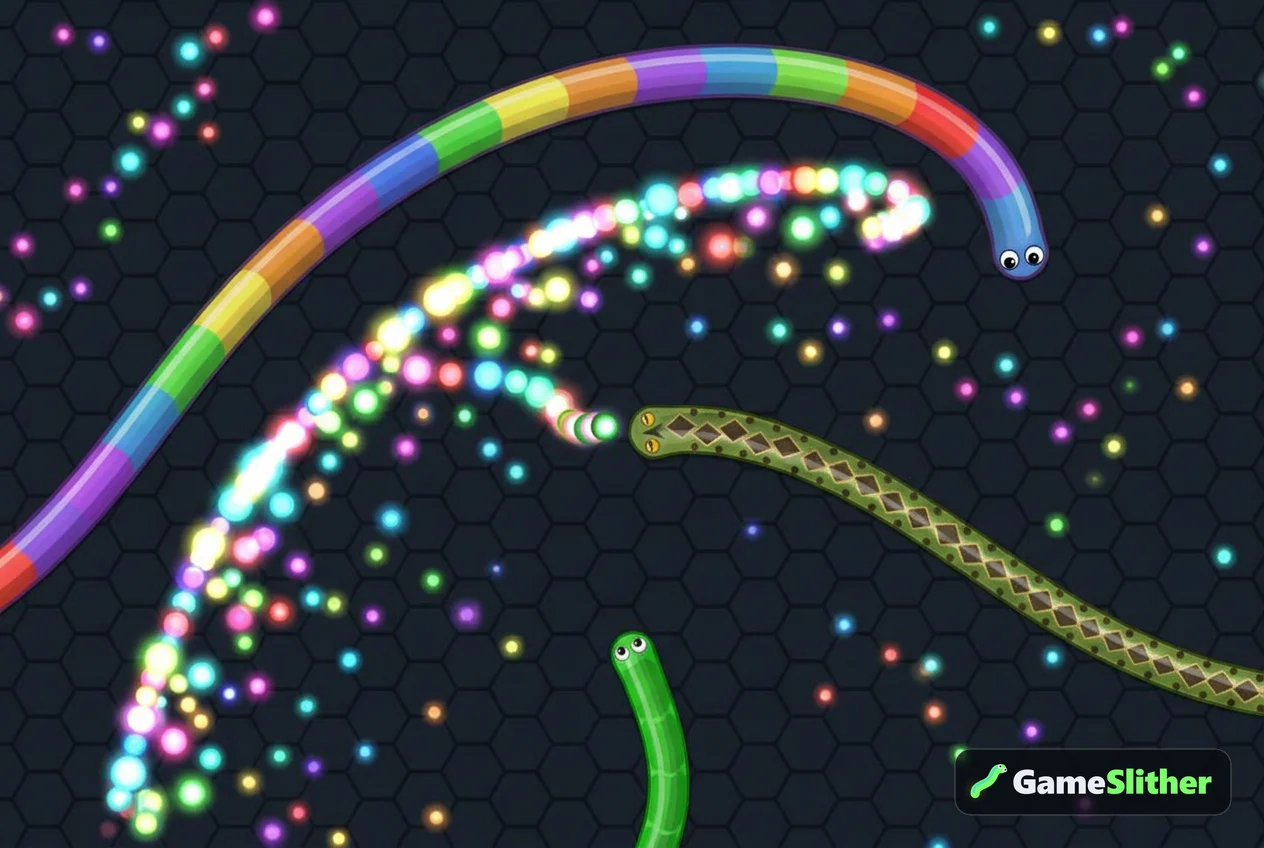
How GameSlither's AI snakes shape your deaths
GameSlither is an independent game built in the slither io style — it is not Slither.io and is not affiliated with it. One thing that is worth understanding, because it directly affects how you die, is how the rooms are filled.
A public room holds around 40 snakes at all times. Real players take priority, and AI snakes step aside as more humans join, up to 50 players per room. Those AI snakes are not random: they come in three personalities, and each one kills you in a different way.
| AI personality | Behaviour | How it kills beginners |
|---|---|---|
| Shy | Avoids bigger snakes and keeps distance | Rarely kills you directly — but it baits you into chasing it into crowded space |
| Hunter | Actively tries to cut off smaller snakes | Swings in front of your head when you are boosting in a straight line |
| Glutton | Rushes to the pellets of defeated snakes | Collides with you in the middle of a death pile |
Knowing this gives you a read. If a snake keeps backing away from you, it is not afraid in a way you can exploit — it will simply lead you somewhere worse. If a snake is angling across your path rather than running parallel, treat it as a hunter and turn away early. And if you see several snakes converging on a glowing pile, assume at least one of them will not brake.
You can read more about room sizes and who you are actually playing against in our piece on how many players are in a slither io room.
A 10-minute routine to stop dying early
Reading tips is not the same as changing habits. Here is a short, structured practice session you can do in one sitting. Give each life a single job.
Life 1 — No boost at all. Do not touch the boost button once. You will survive longer than you expect, and you will learn what your snake's natural speed can and cannot dodge.
Life 2 — Outer ring only. Stay in the quieter part of the map for the whole life. Note your max length on the result screen and compare it to your usual centre-of-the-map runs.
Life 3 — Minimap checks. Glance at the minimap roughly every ten seconds. Count how many times you would have drifted into the edge or into a crowd without it.
Life 4 — One clean cut-off. Find a snake clearly smaller than you, approach from the side, and make exactly one planned cut-off attempt with a short boost. Then go back to farming, win or lose.
Life 5 — Full game. Put all four habits together and just play. Check your result screen at the end: max length, kills, time alive, best rank and coins earned. Those five numbers are your scorecard.
If you want a low-pressure place to drill this, create a private room and share the 4-character code or invite link with a friend. With only two or three snakes on the map you can practise turning, cutting off and death-pile management without 40 other snakes interrupting you.
Common follow-up mistakes once you stop dying early
Once your average life gets longer, a new set of problems appears. They are worth knowing in advance:
- Over-boosting to chase the leaderboard. You can burn 300 length in a few seconds of sprinting. Growth is slow; losses are fast.
- Getting greedy at length milestones. Many long runs end within sight of a personal best because the player starts taking fights they would normally avoid.
- Coiling around a victim and forgetting the outside. The classic trap works, but while you circle one snake, a bigger one can start circling you. Keep an eye on the minimap and leave yourself an exit lane.
- Forgetting the map edge when you are long. A 1,500-length snake needs a lot of room to U-turn. The border punishes long snakes much harder than short ones.
For a compact checklist of the errors that cost new players the most, have a look at 7 snake io beginner mistakes that kill you fast.
Wrapping up
So, why do I keep dying in slither io? Because the game punishes three things — looking at the wrong part of the screen, boosting without a plan, and standing in the busiest part of the map — and beginners do all three at once. None of those are talent problems. They are habits, and habits change in a few sessions if you give each life one job.
Start with the easy wins: eyes ahead of your head, wide turns, outer ring first, minimap every ten seconds. Then add cut-offs once surviving feels automatic.
When you are ready to put it into practice, play GameSlither free in your browser — no download, no sign-up, on desktop, phone or tablet. Try a few quiet lives in the outer ring, unlock a couple of the free snake skins with the coins you earn along the way, and watch your time-alive number climb.
Frequently asked questions
Why do I die instantly after spawning in slither io?
Instant deaths almost always happen because you spawned near a busy fight and immediately moved toward it. Spend the first few seconds steering outward into open space and check the minimap before you pick a direction.
Can my own tail kill me in a slither io style game?
No. In GameSlither your own body is harmless: your head can cross your own tail as often as you like. You only die when your head touches another snake's body. Tight circles are still risky, because a fast spin can point your head into a snake you had not seen yet.
Does boosting make me die more often?
For beginners, yes. Boosting doubles your speed, halves your reaction time and costs length, so panic boosting usually sends you straight into the danger you were escaping. Use it only when you can see your exit.
Are the snakes I play against real people?
In GameSlither public rooms it is a mix. Rooms hold around 40 snakes made up of real players plus AI snakes, and the AI snakes step aside as more humans join, up to 50 players per room.
How long should a good life last?
There is no fixed target, but if most of your lives end under a minute, positioning is the problem. Aim first for consistent three to five minute lives in quieter parts of the map, then worry about the leaderboard.